Chuck_Harbert@arkwright.com wrote:
Paul, I'd like to give you my take on rotary exhaust temperatures based on
what I've learned from others, primarily in your postings. The rule of
thumb is that rotaries run about 200 degF hotter than conventional piston
engines because of continuous power pulses and very little time for heat
transfer to the engine parts at high rpms. You published a rpm vs. exhaust
temp chart not too long ago which showed various BSFC lines. It basically
said that if you run max power type BSFC (stoic-rich) that the higher the
rpm, the exhaust temp just kept climbing thru 1,800 degF for a naturally
aspirated engine.

I've flown in Dave Atkins plane and watched the temp climb to 1,650 (6,000
rpm)under climb out load. He has had to repair his SS exhaust so many times
that he gave up and went to Inconel. I believe that Tracy keeps his EGT
lower because of the lean mixture (lower BSFC) and lower rpm. If you can
control temp then stainless (SS) will probably last quite awhile. However,
if you run a turbocharger and are looking for high continuous output, it is
going to further increase EGT. If this is your plan, I think you may want
to consider Inconel, at least for the turbine wheel. You probably could use
thicker materials (cast iron or SS) as Mazda does, but that adds a lot of
weight.

I've been told by several knowledgeable people that the big problem with
turbocharging a rotary is that you can't make the turbo live because of the
higher EGT. Lots of people have failed trying to really get max power with
high boost turbocharging, and ended up melting the turbine wheel. I hope
they are able to get 900 hp from that 3 rotor, but I'll be surprised if it
lives under load for any length of time, even though everything is Inconel,
unless they can control their EGT to under 1,800. I think it's going to
take a pretty large intercooler to do this, or a ton of excess fuel. Maybe
Tracy's idea of having a long run to the turbo will help him keep his EGT
down. It will also put a significant lag in engine response, but that may
not be important in a A/C application.

 Okay, I'm done, so now everybody can tell me I'm wrong.
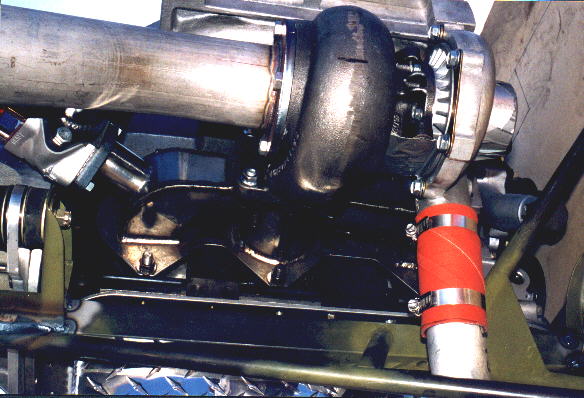
Chuck forgot to mention he is about to fly his turbo three rotor
Velocity with Inconel turbine and Inconel exhaust manifold.
The picture is of Chuck's Inconel exhaust manifold and turbo charger.
3rotturb.jpg

Paul Lamar

The Aircraft Rotary Engine Newsletter.              Powered by Linux.

http://home.earthlink.net/~rotaryeng/            http://www.linux.org