V. E. Welch wrote:
With all of this talk about cooling, I was wondering, how much pressure
differential is optimal across 1) the radiator, 2) the oil cooler, and 3)
the intercooler. I design and troubleshoot control process control systems
for a chemical plant and as such have access to quite a bit of sensitive
test and measuring equipment.  Therefore, when I get to the point of
installing the systems I can set up for some data acquisition BUT I need to
know what I'm looking for.

Vince
RV-8A
hoping for a turbocharged 13B
I used to know the numbers that Lycoming needed across the engine
to insure cooling.

Dynamic pressure is 0.0026 times velocity
in MPH squared. 100 MPH climb speed would be 26 pounds per square
foot or .18 psi. One inch of water is about 5.4 psi as I
recall. P X V = P X V. So now we need to know the pressure drop
across the rad as a function of air velocity through it. You should
be able to get that data from Griffin radiators.
I 800 RACE RAD

The volume of air coming through a five inches high by ten
inches wide or 50 square inch hole in one second at 100 MPH
or 146 fps second is 7300 cubic inches
per second or about 4.2 cubic feet of air per second..

Thats a guess on my part on what is needed for an efficient
P51 type duct opening.

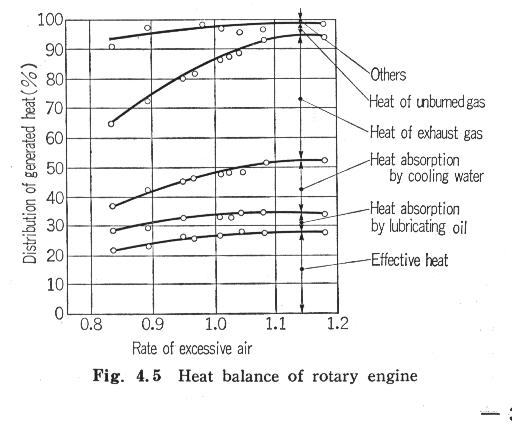
Here is a better heat balance chart from my 1981 RE book
by Ken Y. From this you can see as much heat goes out the
cooling system as goes out the e-shaft in terms of HP.
HP out is labeled "Effective heat".

Lets design for 200 HP. So we have 150,000 watts (at
746 watts per HP) or 509,000 BTU's per hours.
One third of that is oil and two thirds is water.

Again refer to the Griffin rad data. I don't have their
catalog just yet. Anybody have one?

BTW look how much goes out the exhaust! It would not surprise
me one bit if a turbo compound rotary was built that one could
recover as much as 30% more HP with out any increase in fuel
consumption or cooling system heat loss and hence lower the
BSFC to below 0.40. Talk about smoking off aircraft engines!
Shesssss A 290 pound engine (with PSRU) generating a real 260
HP with a 0.4 fuel burn! WOW! What are we waiting for? :-)

hetbal81.jpg

Paul Lamar

The Aircraft Rotary Engine Newsletter.              Powered by Linux.

http://home.earthlink.net/~rotaryeng/            http://www.linux.org