Anderson Ed wrote:
Thanks for the additional info, Tracy.

I was particularly interested in your comments about the significance of
the shape of your airflow splitter and its effect on airflow.  The
opening to my oil cooler plenum is 5" in dia and I put a divider in the
mouth( about 1/3 of upper area) to force about 1/3 of the airflow to the
upper part of the oil cooler. The divider is an approx 1/8" thick layer
of fiberglass that curves from the mouth of plenum, against the plenum
sides to approx 2/3 of the way up the oil cooler.  Did this because my
opening to plenum is near bottom of oil cooler and I figured that a lot
of the air was just shooting throught the bottom rather than flowing
thru the top of the oil cooler.
I could not detect any noticable change.  However, perhaps adding a more
rounded airfoil type shape to the front edge of the divider may help.
That's the frustrating thing about messing with airflow, you don't know
how close (changing the shape) or how far your are from success.
Instrumentation, as Paul keeps advocating is apparently the only way.
Sigh!

Are you getting 5500 rpm with your Performance 68x71 Prop?? I am still
only getting 5000 rpm with my 68x72 at static and am still not getting
over 6000 in level flight.

Ed Anderson
Tedious and careful pressure measurements and pito tube flow
measurements
are the only way to do this kind of stuff. Believe me I started doing
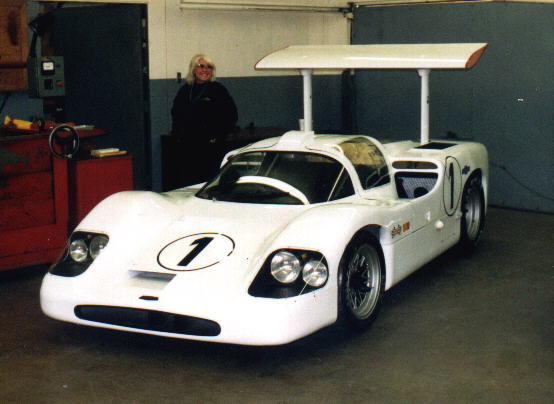
it in 1965. The picture below is my baby. It is the Chaparral 2F.
It won the BOAC 500 outright beating the who's who in legendary
European racing car makes and set lap records all over Europe
that stode for several years afterward. I was largely responsible
for the shape of the body and the cooling ducts. It was designed
in 1965 and as you can see it still looks modern. The suspension
mounted high wing was banned a long time ago as being unfair.

BTW Ed, based on the last pictures we have of your installation
you need a long inlet diffuser on that oil cooler instead of a hose.
Also a turning duct on the back side would help. Also if you have room
move the cooler forward so you can get a smoother outlet duct.

Also BTW the reason Tracy had to shape that splitter was precisely
because he is using external diffusion and the air velocity is higher
through the rad. In an ideal internal diffusion system the rad is
thin and large in area and the static pressure is high
with low air velocity. Ideally the exit velocity is built back
up by the exit duct to exceed the forward speed of the airplane.

In this situation the joint between oil radiator and water radiator
would not matter as long as it was sealed.

On another subject:
A grill over a large opening acts somewhat like a diffuser.
Early airplanes and cars had used this for decades. Cars still do.
I have never seen any data on the efficiency of such an
arrangement however. It would be interesting academically speaking.

I took some pictures of two of the fastest airplanes of
their type yesterday so we can all see how internal diffusion looks
from the outside in regard to opening sizes. Tracy Saylor's RV6 and
Klause
Savier's Varieze for the pusher crowd. Film at eleven PM.

Paul Lamar


The Aircraft Rotary Engine Newsletter.              Powered by Linux.

http://home.earthlink.net/~rotaryeng/            http://www.linux.org