Neil A. Kruiswyk wrote:
Paul

    Fins are placed in the radiator to increase overall surface area thereby
increasing heat rejection.  They are placed perpendicular to the airflow to
reduce drag.  With the radiator setups we have been talking about the air
speed reduction is around 1/3, or from 200mph to 66mph.  That's still mighty
fast so the last thing you'd want to do is angle the fins (if you can avoid
it).
I am not sure I agree with this speed reduction Neil. Have you stuck
a tiny pito tube in there and measured it? We do need some of this data
to really tell what is going on. Don't forget to use the static pressure
in the duct as a reference pressure for the pito tube.
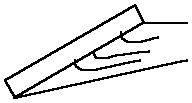
    Airflow through the rad will decrease exponetially as the angle
increases.  It will also be reduced relative to incoming air speed (drag
quads as speed doubles).  If the angling of the fins can not be avoided the
the air must be helped to make the bends with divertors.  Idealy both before
and after the rad core.  (see lousy picture I did in 2 mins)
Diverters do not always help. They sometimes add problems of their own.
    Your note about radiators in modern cars being big and thin...  Thinner
is better without a doubt.  Heat transfer is a function of delta T.  The air
heats as it goes through the core so the thinner rad will have a greater
temperature difference 1" in from the front than say 5" in from the front
and therefore more heat transfer.  Unfortunately, airplanes don't have the
frontal area of modern cars so we make the rads thicker and pump more air
through them.  Modern cars have little or no grill to them these days but
rather a giant air dam under the bumper to deflect air into the big, wide
rad.  I think overall hood styling has more to do with radiator design these
days.

IMHO

Neil

PS: did you get my email on the size of my new rad?  the core is 17" x 13" x
5.5".  With tanks it's 20" wide.  By your calcs.. 1430 cu in.
Yes I did Neil thanks. I am waiting with bated breath to see how
your new rad and duct system works.

Neils-turning-vanes.jpg

Paul Lamar

The Aircraft Rotary Engine Newsletter.              Powered by Linux.

http://home.earthlink.net/~rotaryeng/            http://www.linux.org