Jeff Spitzer wrote:
O.K. here's my $.02 on the subject of angled radiators.  Imagine that each
core passage (the little square passage formed by two fins and two water
flow tubes) is a pipe facing into the wind.  The air will have no trouble
flowing into the passage and the amount of external diffusion required
prior to entering will be strictly based on the length and surface
properties of the passage.  Now incrementally rotate our square duct away
from the relative wind.  Any layman can see that the flow will immediately
separate from the upstream wall.  Remember, we have no nose radius here!
The amount of air entering the passage will be reduced because the flow
area will be contracted by the separation.  When the duct reaches 90 deg.
no air will flow in due to ram pressure.  At this point the only way to get
air to flow in is with static pressure in an upstream duct.  The point is
this:  If the radiator is aligned with the incoming flow, no additional
losses are associated with entering.  (not really but O.K. for the sake of
my argument)  If the radiator is tilted then the separation in the entrance
of each little flow passage will cause additional losses.  This is not to
suggest that I would never tilt a radiator, I would.  But I would do so
knowing that there is a price to pay.  (If anyone really cares I can tell
you how to calculate it).  The quick sketch that Neil did is probably worse
than nothing at all.  That's because if not done right the air will
separate from the fins and cause non-uniform flow through the HX with no
decrease in drag.  In a word: worse.

Jeff Spitzer
Here is my $.02. I think a lot depends on the velocity of the airflow
and the pressure difference across the core. If the velocity is real low
and the pressure difference is real high there will be flow through
the core no matter what. It would matter little if the air had
to make a ninety degree turn through the core.

With  an ideal diffuser and a limit condition the pressure would
be infinite the velocity near zero.

Core drag would be near zero and the system would make a
damn fine engine or waste heat energy recovery system when the
air was finally speeded up in the exit nozzel to provide thrust.

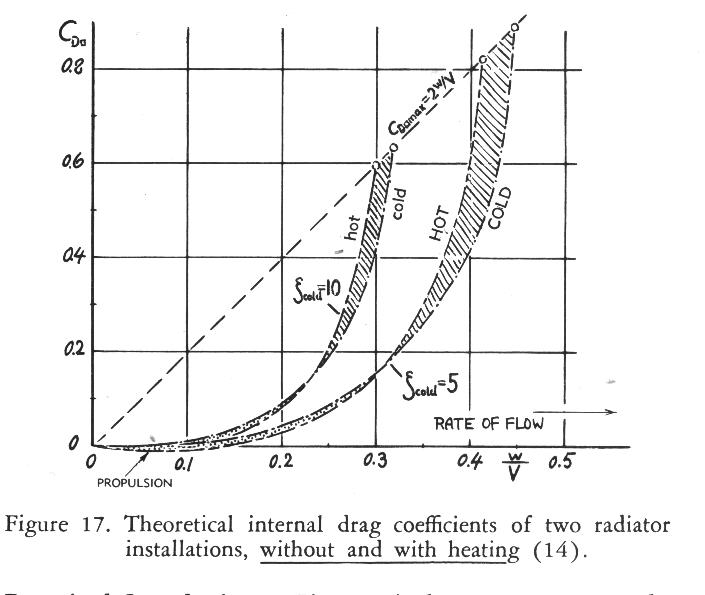
Hoerner Fig 17 suggests just that.
Look at the left side of the chart.

w can be taken as the velocity through the core and
V the velocity of the airplane. C sub da is the overall
drag coefficient of the system.

Perhaps this is an argument for thick.


Paul Lamar         hoefig17.jpg

The Aircraft Rotary Engine Newsletter.              Powered by Linux.

http://home.earthlink.net/~rotaryeng/            http://www.linux.org