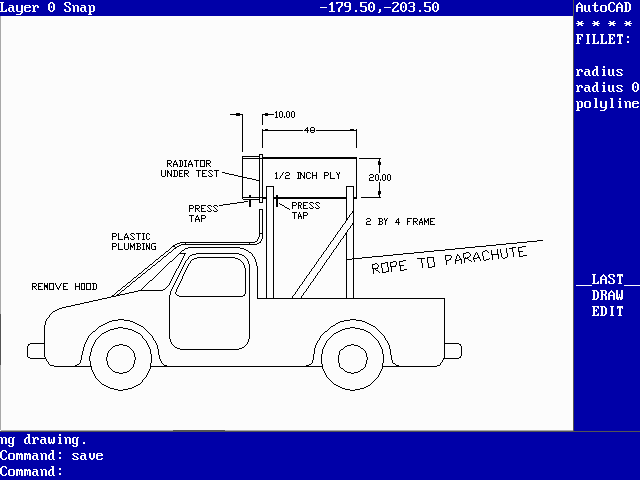
Jeff wrote:
Here's a sketch of the simplest way to test the radiators to allow
proper
design.  This is the way I would do it:

Measure ambient pressure and temperature to know density (rho).
Measure free stream velocity (V1) with pitot static tube beyond truck
slipstream (not shown)
Measure pressure just inside minimal inlet lip (P2).  Don't worry about
separation on outside...it doesn't matter.
Capture area=lip area *(1-(2*P2/rho/V1^2))
Mass flow=capture area*V1*rho
Measure flow of hot fluid somehow and also vary it.
Measure temperature of coolant into and out of heat exchanger.  No need
to
measure temps of airflow.
Vary airflow (massflow) with truck air speed.
Don't mix duct tests with radiator tests i.e. use a simple square duct
here.
 I don't have any problem with the plastic pipe if you think it can take the
 pressure and temp.  My guess is it's marginal but probably O.K.  I don't
 like the idea of using the truck engine as the *only* heat source.  The
 best test is to have a consistent flow and inlet temperature for all
 radiator tests.  The flow to the truck radiator will vary based on
 thermostat position (if your test rad does well then the thermostat will
 shut it down) and the temperature will vary too.  Where's that boiler you
 said you found?

 Jeff Spitzer

It is the parachute.Off the shelf for drag racers.
Or make one out of heavy canvas or sail cloth.

Paul

 Aren't the cops gonna have a problem with that?
 Are you gonna bypass the thermostat?

Jeff Spitzer
Hopefully we are going to do this out in the desert,
possible at night. They would also have a problem with 100 MPH :-)
Fortunately a data point should take just a few seconds.

The parachute is to keep the thermostat open if needed.
With that mess up in the airstream I don't think it will be needed
but just in case. Usually a ring is used to control the opening size.

The whole mess needs to be tied down in the truck bed real well or that
parachute will pull you and the test rig out of the truck for a wild
ride.

Paul Lamar

The Aircraft Rotary Engine Newsletter.              Powered by Linux.

http://home.earthlink.net/~rotaryeng/            http://www.linux.org