Tracy Crook wrote:
BTW the only rad I have come up with so far worth testing is the Suzuki
Swift
or the Geo Metro. Those are the only ones I have found so far near the
right
size. If we need more thickness we can double them up in a back to front
flow
hot water arrangement. The durabilty issue can be solved by mounting
them in a ridgid frame.

Paul Lamar
Unless you go the first class route and order custom radiators, it is hard
to beat the Harris evaporator cores like Ed & I use.   I am a real believer
in them now as far as BTU / cubic inch, cost, weight, etc goes.  They will
take 200 psi & never fail to boot.

BTW, to understand why I think angle relative to incoming air is not
important on these things, take a close look at one.  They are so dense due
to the "turbulence louvers" in the fins that light will not shine through
them at all.  Jeff's analysis of airflow through a typical radiator was
technically perfect but these things are a different animal.  One look at
them will convince most anyone.   The down side is that it takes a lot of
pressure to make enough air flow through them.  I would not even try making
them work on a sub-100 mph airplane.  Just not enough static air pressure to
work with.

Tracy Crook
 rws@altavista.net
I will agree with you on the cost Tracy. There is no beating five bucks
in the junk yard. The 200 psi just adds weight when all you need is
30 to 50 psi.

There is however another down side besides the pressure required to
force air through them. The efficiency of the core from a heat transfer
mode is bad merely due to their thickness.

That is Jeff's main point I suspect.

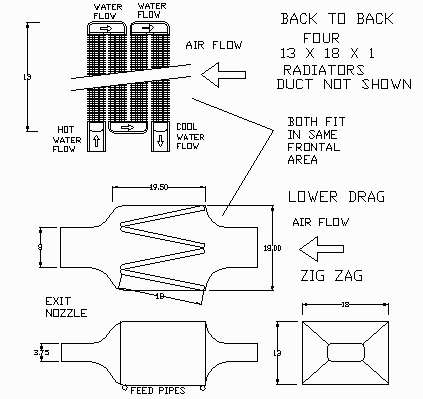
By doing what I mentioned above and using several thin cores back to
back a thick core can be made to work much better.

Here is a sketch of both the back to back configuration
and the zig zag configuration. I previously uploaded the back
to back but since your mailbox was full Tracy you may not have
seen it thus far.

The duct shown is just for illustration purposes. It will have to
be modified to fit in the fuselage area of a real airplane.
I think a large NACA duct in the bottom of a low wing airplane
might be the way to go in this regard. It would be easier to
implement in an aluminum airplane then a P51 style duct.

The zig zag arrrangement has one other advantage in the context
of a low wing airplane and that is the elevator push rod
can pass between the center rads with out modification.

Paul Lamar          thick2.gif

The Aircraft Rotary Engine Newsletter.              Powered by Linux.

http://home.earthlink.net/~rotaryeng/            http://www.linux.org