Jeff Spitzer wrote:
Tracy must have caught me at a vulnerable time.  He almost slipped one past
me.
Tracy Crook wrote:
I think we are talking about two different kinds of efficiency here.  I
agree that for a given fin area, the thin radiator is more efficient in
terms of dropping the water temperature a given number of degrees.  It
is an
efficient radiator.  I was addressing the aerodynamic efficiency of the
cooling system as installed in the airplane, i.e.,  having less overall
cooling drag.    It WILL take more fin area in the thick radiator to do the
same job (air at the back side is hotter and therefor less temp
differential
between air & water).
Yes, and I will use this later to make my point.
Jeff has a valid point in saying that the air could be slowed down in the
thin radiator to accomplish the same thing but there are a number of
factors
which work against this approach, especially in aircraft applications.  Not
only does the size get out of hand but the same factor (low air velocity
leading to laminar flow, etc.) starts to work against the thin approach.
Plus, if you slow the air down to the point where the air is heated as much
at its rear as in the thick radiator (less temp differential between air &
water), what is the thin radiator's advantage?
Less pressure drop!!!!!!
To avoid a long winded discussion of all the steps in between, let's
look at
the inputs and outputs of the cooling system.   First we have to agree that
less CFM (of air) through the cooling system will equal less drag, all else
being equal.  I will assume we agree here.
This is where you tricked me.  It was the all else being equal part.  If
all else is equal then the statement is true.  But all else can't be equal!

If not, stop reading here and we
will discuss this area first.   Remember I am talking about total aircraft
cooling drag, not air resistance of the heat exchanger itself.  One does
not
equal the other.  It may not be intuitively obvious, but If you have
understood the discussion on air diffusion & ducts so far, you will already
know that the airplane would have less drag if you plugged up the airflow
through the radiator.

   For a given number of BTU  heat rejection, the system which uses the
least number of CFM to do the job will be the one which heats each one of
those cubic feet of air the most.  i.e., You can reject a certain amount of
heat by heating 100 CFM of air to 50 degrees above ambient, or, 200 CFM of
air if you only heat it to 25 degrees above ambient.

 It is my contention that in the context of an airplane, the job of heating
the air the most is best accomplished by a thick and very dense (lots of
air
turbulators as Jeff described) radiator.  It is absolutely true that you
will need more core (fin) area with this approach  but minimizing core area
was not the goal, cooling the engine with minimum cooling drag is.
Again,
such a radiator requires a relatively high differential air pressure and
this is why the past discussion on pressure recovery in the cooling inlet
ducts is important.

I now await the storm of contrary opinion  :-)

Tracy Crook
 rws@altavista.net
This argument was very cleverly crafted.  There's one fatal flaw that I
didn't realize until after I responded.  The aircraft drag is not related
to CFM, its CFM *TIMES* pressure drop.  So, in Tracy's words, all else
being equal (duct efficiency, that is) the HX with the lowest product of
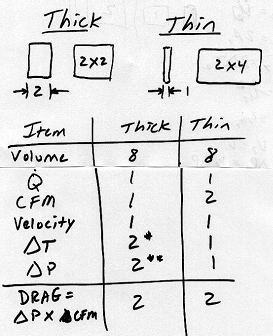
CFM*deltaP is the lowest drag installation.  The attached chart shows a
comparison of two HX's with all else being equal.  The following notes apply:
* The temp rise for a HX of double thickness cannot possibly be 2X the temp
rise of an otherwise identical HX of single thickness.  That is because the
temp difference issue.  Therefore for equal heat rejection (Qdot) the thick
HX must actually be as much as 3x thicker.
** I think we can all agree that an identical construction HX of double
thick will have 2x the pressure drop of a single thickness for the same
velocity.

The conclusion is:
Based on the attached charts the double thick HX would have to have double
temp rise to be as "drag efficient" as a thin one of equal construction and
volume.  Because we all recognize that this cannot be done, the thick HX
can never actually be as efficient.  End of story.  BTW, my airplane will
probably have a thick HX because I cannot fit a thin one :)
Jeff Spitzer
Don't forget to make up thick rads from thin rads and use the hot in the
back trick to make them work better.

Paul Lamar             Jeffs-thick-v-thin.jpg

The Aircraft Rotary Engine Newsletter.              Powered by Linux.

http://home.earthlink.net/~rotaryeng/            http://www.linux.org