Donald Sherman wrote:
Sure it has advantages.  But they're all hypothetical until someone does
the development.  And who will that be?  Jim Mederer, a one-man band?
Mazda?  No way Jose.  The US government?  get serious.  The Orenda has
already gone through that phase.  It's certified and on the market.
There's no rotary that comes anywhere close to it now and there probably
never will be.
The 3- and 4-rotor couplings are identical in design but differ in number:
one is used for three rotors, two are necessary with 4.  Their durability
is not proven at the power and rpm levels we're talking about.  Mazda has
absolutely no turbo-rotary racing experience.  Jim Mederer has to be
considered the world expert on the subject and he is quite skeptical.
With all due respect to Jim he is playing catch up to the drag racers.
They were the ones that discovered high boost and laughing gas.
He was rather surprised when I showed him Abel's dyno chart.
The problem with the coupling design is inertia related.  Since the rotors
must be externally balanced, the eccentric shaft carries tremendous bending
loads.  It is not particularly well supported.  The result of those bending
loads passing through a tapered connection is a shift in shaft alignment
through the coupling.  In other words, the shaft doesn't stay straight.
The proper solution with more than two rotors:  a larger coupling with
higher clamping load and larger main bearing journals (width and diameter).
Hey Don that's a peice of cake compared to a  crankshaft:
Stress concentrations are a crankshaft's middle name.
All they need do is machine it differently and heat shrink it on.
Course getting the engine apart for service later might be a problem.
The cam gear in my O-470 is heat shrunk on its shaft.
Lighter rotors made from ti would solve the problem in a flash.
 It's precisely what was necessary to convert the hotrod Chevy engine into
an Orenda aircraft engine.
No way! Not even close!
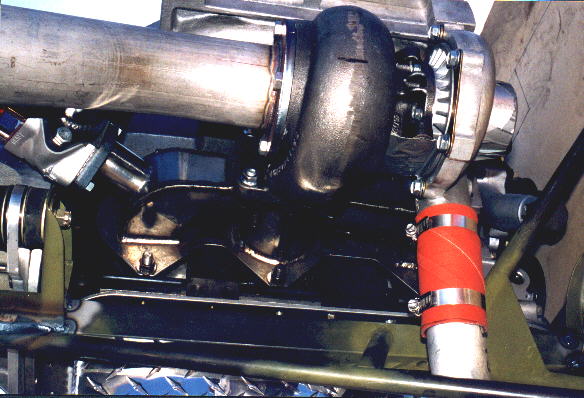
The turbo deal goes far beyond hanging on a $800 off-the-shelf
turbosupercharger.  Mederer reinvented the exhaust flange design,
converting from 2 to 4 attachment studs.
No big deal. Sheessss! You drill and tap four holes.
I don't think he invented that. Everett Hatch had that a couple of years
ago on his rotary in Allan Tolle airplane.  There is a picture of
that on my web site under exhaust systems. Did Jim tell you that?
He invented a silver-plated
C-section seal that uses gas pressure (like a dykes piston ring).  He
installed a bunch of inconel bellows pipe connectors at $150 each.  And
this is just for starters.
You want a picture of an Inconel three rotor exhaust manifold on an
airplane up in Seattle? See below.  This is Chuck Harberts in a
Velocity.
3rotturb.jpg
Next he must map the controls (spark, fuel,
boost), find and fix the bugs, package the hardware for flight.
I am telling you Don you are out of it. Tracy Crook with 800 hours
on his rotary engine powered RV4 has designed and built his own
efi/ignition system with MPG in the air no less. (input from
GPS) and sells it for $800 to other people with rotaries in aircraft.
Jim is using an off the shelf car racing efi from Ole Buhl.
http://www.obr.dk/


If you you were not overwhelmed by
the twenty or thirty messages a day we process on the ACRE newsletter
I would sign you up and you would learn a lot about rotary
engines in airplanes. I have about 500 subscribers world wide so far.
That of
course doesn't address any of the torsional vibration problems associated
with turbine blades that will surely make life that much more difficult for
the eccentric shaft coupling.
Now Don... tell me how the turbine blades have anything at all to do
with the coupling. Are you trying to bull shit me?
Ultimately, this rotary will only fly if:
Mederer's demonstration of feasibility experiments prove successful
an extensive development program is conducted
the design is divorced from Mazda's obsolete street engine
So its a 13G there are only minor differences between a 13G and a 20B.
naturally the cost will be astronomical--just like the Orenda project.  By
then the aviation world will have said goodbye to gasoline.  And how well
will this engine run on kerosene?  NOBODY KNOWS, particularly you.
Your ignorance is showing again Don. The parent company in Germany is
running their aircraft Wankels on Jet A.
Have you even looked at my web site?
Just click on this with your mouse.

http://home.earthlink.net/~rotaryeng/

Then select Wankel GMBH under "Interesting web sites"
Meanwhile the junkyard experimenters can have a field day flying their
rotor motors and speculating how wonderful that engine would be if only
somebody would spend a few hundred Million to prove these theories.  And by
the time you add enough turbine in the mix, you're right back at the cost,
smoothness, reliability, and performance of what you started with:  a turbo
prop!  So why bother?  DS
Cost and fuel burn. A turbo prop cost $250K and burns 0.65 pounds per
HP/hr.
while the three rotor is well under $50K and burns 0.5 pounds per HP/hr.
Not to mention a turbo prop sucks at anything over 20,000 feet.
A turbo three rotor will go to 35,000 feet no problem.

Paul Lamar

The Aircraft Rotary Engine Newsletter.              Powered by Linux.

http://home.earthlink.net/~rotaryeng/            http://www.linux.org