Mike Wills wrote:
At 11:36 PM 3/18/99 -0800, you wrote:
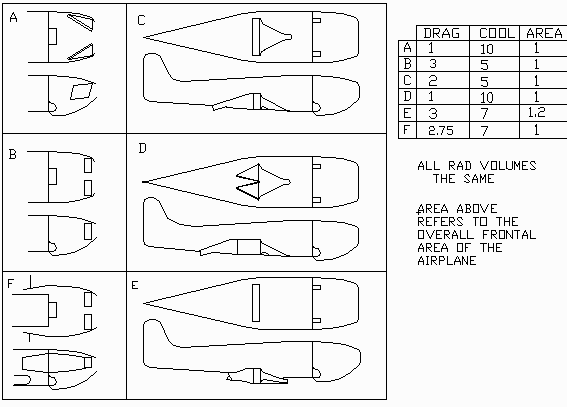
A zig zag arrangement would transfer the same heat
or more heat  with less velocity loss hence less drag.

Paul Lamar
Paul,
 After seeing your picture I do finally "get" what you've been saying
regarding "zig-zagged thins". I still think that Alan makes a valid point
regarding failure modes with multiple hoses/couplings. I suppose that could
be overcome by using a "thick" (3 or 4 row) core minus the tanks and then
welding on your own tanks with appropriate baffling to force triple pass or
quadruple pass coolant flow from to back to front.
 Im not convinced that "thins" with large frontal areas are more efficient
with less drag when installed at a significant angle to the airflow, than a
smaller frontal area "thick" which is oriented perpendicular to the
airflow. This is contrary to all I have read, and refuted by a number of
folks Ive talked to who have tried it that way. Can you cite some
documented testing of this? Specifically, refering to your drawing
coolcom2.gif which you sent out as an attachment on 3/14, can you point me
to anyone who has tested config A versus a modified version of B in which B
has a proper diffuser duct in front of the radiator? Of course for this
test to be valid it would have to occur on the same airframe under the same
conditions.

Mike Wills
Its all theory so far Mike. It is all based on the fact the air is going
slow when it goes through the core at around 90 degrees so the velocity
and pressure loss is low. For example what Allan is proposing is
basicaly
the same idea. He proposes a vertical rad behind the engine. The air
must make
two 90 degree turns to get out of the cowl after that.

Jim Mosur is flying the A set up but he only has a few hours so far in
the dead of winter in the Great White (and cold) North.

One of the hidden points is it is hard to get a proper diffuser in front
of configuration B. It assumes external diffusion with a big opening.
If your internal diffuser is working well you should get good cooling
with
two round 4.25 diameter holes. Tracy Crook is using B and his holes are
much
larger than that.

I would love for you to test it however. Do you have a pickup truck? :-)

Paul Lamar          coolcom2.gif

The Aircraft Rotary Engine Newsletter.              Powered by Linux.

http://home.earthlink.net/~rotaryeng/            http://www.linux.org