Mike Wills wrote:
At 11:22 AM 3/25/99 -0800, you wrote:
I checked the web site and they do not appear to have stock sizes
listed.

To save me requesting thier catalog and saving time and assuming
you have the catalog... do they have something around 15 inches by
15 inches by one or two inches thick? One and a half inch thick
would be near ideal.

The other thing I would like to know is; can they build a
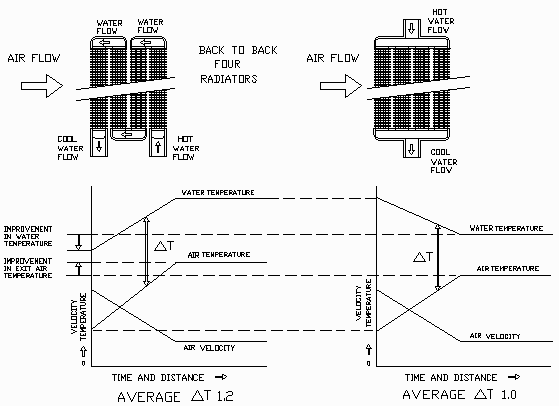
back-to-front four one inch thick  rads making up a four inch
thick overall rad arrangement?

Can you think of a sceanrio to tell them what you are going to
use such a weird configuration on? :-)

Paul Lamar
Paul,

 Their custom rad shop is a division of their primary business which is as
an OEM supplier to the industry. According to the sales engineer that I
spoke with, they dont have any "stock" sizes because since they manufacture
their own cores and tanks the user can specify any core size, tank config,
etc.. The catalog that I have shows the same pricing given on the website,
i.e. pricing based on the number of rows in the core irrespective of the
core dimensions.

 They have cores that go all the way up to 5 rows available. They also
build the typical sort of double pass and triple pass rads you see commonly
on race cars. I dont see why they couldnt build a multi-pass rad with the
baffling arranged to provide back to front flow, but you would have to ask
them to know for sure. I'd bet that it would be expensive (all their stuff
is), but the rads I saw there were worth the $ they charge in my opinion.

 They were not totally against the idea of selling for an aircraft
application but the engineer I spoke to told me that they would not provide
any engineering support to help determine whether or not the rad I
specified was appropriate for the task. They wanted me to sign a liability
release, and then they said it would need to be run past the company
president for final approval. When I spoke to them I was looking for a 4
row core in a double pass config with a built in water-oil exchanger built
into the unbaffled tank. My thinking was that on the first pass thru the
rad coolant temp would be lowered significantly, then it would pass over
the oil-water exchanger picking up heat again, and finally a second pass
back through the core to cool again before entering the engine. They show
several such rads on their web page under "custom radiators w/ heat
exchanger". I told the engineer that I was putting it in an airplane
because I wanted his opinion as to whether or not my theory was all screwed
up, and if the size of rad I was proposing was sufficient. He assured me
that there are racers using that type of config in various types of
endurance racing (including Mazda 13B applications) but then stated all
those caveats I mentioned before. I simply think that it would be easier if
you told them you were building an endurance racer of some type, or maybe a
car for salt flat LSR type racing. If you were building a salt flats car
that would explain the small frontal area, and as far as the back to front
goes, tell em its to test a theory of yours. These guys supply the "money
is no object" racers so if there is a theoretical advantage to back to
front theyve either done it or they would probably be extremely interested
in doing so.

Mike
I did just that. I sent them this drawing asked them if
they could make it.

No word back so far.

Paul Lamar     thick3.gif

The Aircraft Rotary Engine Newsletter.              Powered by Linux.

http://home.earthlink.net/~rotaryeng/            http://www.linux.org