The rotary needs to be turbo-compounded!

Read the results
of Allison's experience in 1944/1946. I had no idea
this program even existed. It must have been kept secret for
forty years. The blow down turbine added almost 900 HP
to the V12 with little or no increase in cooling load on the
basic engine. I am truly facinated by this concept.

Here is another excerpt from the book Vee's For Victory
by Dan D. Whitney. 1998 Schiffer Publishing Ltd.
(610) 593 1771.

"Bell XP-63H, with Turbo-Compound V-1710-127(E27)

By 1944 Allison had its mass production problems under control and
reliable engines were being delivered in large numbers. Allison
engineers were then able to tum their attention to the increasing
demands for improving  the performance of Allison powered aircraft.
Military tactics required improved takeoff performance, to carry
ever greater quantities of fuel for the  long range escort missions,
and at the same time provide more power at ever higher altitudes,
necessary to provide the tactical advantage in combat.

It was well known that recovery of some of the nearly 50 percent of
fuel energy wasted in the exhaust gases could go a long way in
meeting these objectives. So in 1944 Allison launched a major effort
to improve the V-1710 and satisfy the demands from the operating
theaters. The path selected was to develop a "turbo-compound"
engine, a concept where the hot exhaust gasses power a turbine
geared to the engine crankshaft where it can contribute to the power
delivered to the propeller. This was an ambitious development for at
the time no one had ever flown such a machine or ever demonstrated a
practical engine/turbine setup.

The project went through several development and test phases. In
these, component parts were subjected to extensive performance
testing under conditions similar to those the final V-1710-127(E27)
turbo-compound engine would see. The actual engine utilized
components from the latest Allison standard: the V-17 10-G that was
developed and rated for operation at 3200 rpm, with high manifold
pressures and able to operate at sustained high power. Its major
component differences from earlier models involved using the 12
counterweight crankshaft and pistons having reduced compression
ratio of 6.00:1 instead of the previous standard of 6.65:1.

The concept followed Allison's basic design approach of interfacing
stand-alone components with minimum redesign of each, and thereby im
posing minimum impact upon the production line. The engine was
configured as a "E" model, for driving a remote reduction gear box,
and provided with the usual integral engine supercharging stage. It
was also mechanically coupled to an Auxiliary Stage Supercharger,
giving the configuration a two-stage breathing capability and a high
critical altitude. The Auxiliary Supercharger was modified to allow
direct connection to the power recovery exhaust gas turbine. This
device was derived from the GE Type CH-5 turbosupercharger, as used
in 2800 bhp late model P-47's and R-4360 powered bombers.

The turbine was provided by GE as their CT-1 power turbine. Three of
these were obtained. It differed from those in the Type CH-5
turbosuperchargers in that the nozzles and buckets were arranged to
drive the wheel in the opposite direction. It had a similar nozzle
flow area of 16.5 square inches and operated with an efficiency of
about 62 percent. No waste gate was provided, as it was intended to
operate the turbine at all times and the sizing of the nozzle area
defined the maximum turbine power and engine backpressure. GE
established the maximum allowed exhaust gas temperature into the
turbine at 1725 degrees Fahrenheit, this being significantly higher
than the nominal 1600 degrees seen in normal turbosupercharger
operations. It was clearly at the upper limit for the design and
available turbine materials. This temperature limitation was the
"Achilles Heel" of the project.

The project did not really get underway until Contract
W-33-038-ac-7191 was approved in January 1945. At that point, the
engine was described a having a 2.48:1 reduction gear and was to be
suitable for use in the P-63 airplane with a total weight of 1,983
pounds. Three of the engines were to be built from existing
V-1710-109(E22) cores, though only one and a working test mockup
were actually built. The test mockup was completed in June 1945 and
the first full engine that September. Military ratings were on Grade
100/130 fuel are shown in Table 6-7.

Allison proposed adding an aftercooler to remove 50 percent of the
compression heat, which would improve the performance as shown in
Table 6-8.

It was found by testing that with the engine at 3200 rpm, and at
11,000 feet, with water injection and 100 inHgA manifold pressure,
the turbine caused a back pressure of 70 inHgA and delivered 890
bhp. At this manifold pressure, and with the turbine coupled to the
engine, 2980 bhp was being delivered to the propeller! The turbine
was directly connected to the engine through 5.953:1 gears contained
in the Auxiliary Supercharger gearbox. The connecting shaft was
concentric with the Aux Supercharger impeller, but the impeller
continued to be driven through its hydraulic coupling. In this way
the Aux Supercharger only consumed the amount of power necessary to
provide the demanded pressure at the inlet to the engine-stage
supercharger. This minimized the temperature of the air delivered to
the engine and the likelihood of detonation.

Ducting of the hot exhaust gases from the engine to the power
turbine was accomplished by using late model P-38 manifolds and
fittings. These were suitable up to the maximum back pressures,
which could reach 100 inHg, nearly 50 pounds per square inch at 1725
degrees F.

The one-off Bell XP-63H began as a P-63E-1, with modifications to
accommodate the turbo-compound Allison engine and function as a
flying test bed. The fuselage was not lengthened since the P-63
series was already "stretched" to accommodate the two-stage
Allisons, i.e. those with the Auxiliary Stage Supercharger. At first
it appears that the installation was somewhat crude, in that the
exhaust manifolds were simply run external to the fuselage. In fact,
this was an attempt to accomplish a degree of exhaust gas cooling
prior to passing it to the turbine, with its critical temperature
limitations. The P-38 type collector manifolds were bolted directly
to the V-1710 cylinder blocks, and were covered with a simple sheet
metal shroud open on both ends. This extended into the airstream and
continued to just past the rear of the cylinder blocks. From this
point, the circular pipes were extemal to the fuselage back to the
point where they entered through a circular cut-out, connecting to
the turbine nozzle box situated on the centerline of the aircraft.

The turbine exhaust was then collected by a shroud and ducted to a 12
inch diameter ventral exit also on the fuselage centerline. This
required the elimination of the ventral stabilizing fin normally
seen on late model P- 63's, hence the profile of the XP-63H
resembled the earlier P-63A and C models. At maximum power and
altitude this exhaust duct configuration should have been able to
contribute an additional 100-200 pounds of net propulsive thrust,
though no exact figures have turned up. The only other significant
modification was the relocation of the oil tank, details of which
have not been found, though it appears to have remained near the
usual P- 63 location.

All of this suggests that the XP-63R may have had a fairly "aft"
center of gravity. The V-1710-127 was expected to weigh 1,950
pounds, dry.  in The dry weight of the V-1710-109 for the P-63E
weighed in at 1,660 pounds. The CT-1 alone probably weighed about
150 pounds, and was certainly  located quite far aft. Possibly, the
ventral fin removal assisted in restoring balance, but a fair amount
of ballast was going to have to be fitted into the nose compartment.
To this end the starter and generator were mounted on the propeller
reduction gearbox.

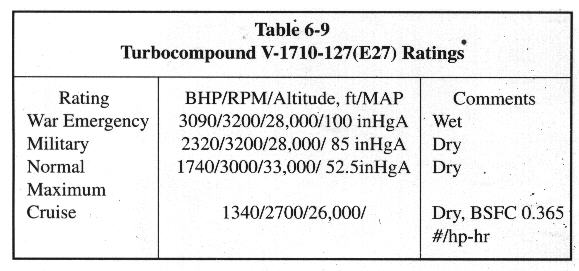
Even so, the V-1710-127(E27) was quite a performer! Allison's
proposed guaranteed performance, on AN-F-33 Grade 115/145 fuel and
incorporating a turbine able to operate at 1,950 degrees F is given
in Table 6-9.

The "Achilles Heel"
Lean Fuel/Air mixtures are known to cause high exhaust gas
temperatures.  Allison found that even the normal "rich" mixture
ratio of 0.08:1 pounds  of fuel per pound of air, and water
injection sufficient to depress detonation at 100 inHgA, the exhaust
gas temperature would still be 1825 degrees F. The result was that
they believed that a air-cooled power turbine able  to operate with
1950 degrees F gas would have to be developed to realize the
promise of the turbo-compound. While Allison proposed to provide
such a device, later in 1946 they changed their mind, believing the
effort could  be better directed to establishing Allison's role in
the field of jet propulsion. Consequently the program was terminated
and the V-1710-127 and  its XP-63H testbed never
flew.

In 1942 Curtiss-Wright Aeronautical Corporation had begun
investigations and design studies that finally led to Model Testing
the TC 18, a  a turbo-compound, 18 cylinder R-3350 in 1950. Wright
had begun development testing in 1948, and developed a configuration
achieving the desired high efficiency. This engine went on to become
the mainstay of the final generation of piston powered airliners and
bomber aircraft such as the Douglas DC-7, Lockheed Constellation,
and Lockheed P-2 Neptune. To accommodate the high exhaust gas
temperatures Wright developed aircooled blading for their power
turbine. It was a good approach, but it still lagged several years
behind the Allison program that developed the first turbo-compound
aircraft engine, the V-1710-127."

alliturb.jpg

The Aircraft Rotary Engine Newsletter.              Powered by Linux.

http://home.earthlink.net/~rotaryeng/            http://www.linux.org