Dale Smith wrote:
Firstly, to all the (very knowledgeable) engineers on this SIG, I
would
like to say, pardon the ignorance.  I have long been a proponent of
the
KISS (Keep it SIMPLE, Stupid!) philosophy for aviation, both for
reduced
costs, and lack of things to go wrong!  This is one reason I champion
the rotary engine for aircraft use in the first place.

My question is:  Given the speed of sound figure recently mentioned,
(803,820 in./min.) and taking 90% of that, coupled with the figure of
6000 rpm shaft output that seems to be generally agreed is a good
conservative continuous operating RPM for the rotary engine, I come up

with a prop diameter of 38.4 in. (~1 meter) ... DIRECT DRIVE - NO
PSRU.

Wouldn't this be preferable, especially in a ducted fan (multi-blade)
pusher configuration, to the cost, complexity, weight, and lubrication

problems one buys into with a PSRU?  Just to swing a larger diameter
(off the shelf?) prop?  ... Sorry, you tractor guys :-(

I know that torsional vibration is a problem, but must admit that I
don't understand it, and why it is eliminated by planetary gears,
clutch
plate, or whatever.  One reason I like the rotary is for it's
smoothness
and lack of vibration.   If aircraft piston motors can direct couple
the
prop to the crank, and have power pulses and vibration all over the
place ... why can't we?  Especially if we are willing to tackle the
problems of the ducted fan?
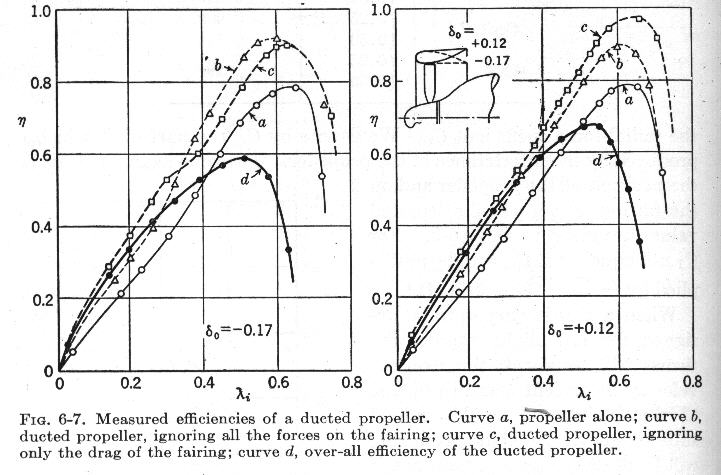
Knowing what little I know now about the subject of ducted fans I think
the overall efficiency  will be down about 20%.

Unless you have a large curved lip on the fan duct, the static thrust
will be rather poor as well. This lip will then add a lot of drag at
high speeds.

Helicopters need a lot of static thrust and they use very large, slow
turning propellors with out ducts. The
Fenestron(sp?) on the other hand is a ducted fan used as a tail rotor.
In that case there is no axial velocity of the fan to add to the drag.
It merely sucks air through and over large radius lips that generate's
low pressure on the lips surrounding the fan and hence side force to
counteract the rotor torque.

All turbofans on airliners are ducted fans. The saving grace is they
have so much excess power that they can afford
to accept low eff during takeoff. GE tried an unducted fan on an
airliner and found at least 20% better efficiency.

The best book I have found on the subject so far is "Aerodynamics of
Propulsion" by Kuchemann & Weber.
McGraw-Hill 1953. Great book BTW. Very good chapter
on ducted radiators as well.

ductfan1.jpg

The chart shows the situation quite well. Lamda sub i
along the x axis is the internal rate of advance. That is just another
way of saying the ratio of the actual velocity of the air in the duct to
would it should be based on the
pitch and RPM of the blades if there were no slip.
The y axis is efficency. Just like prop efficiency.

This is for low disk loadings. High disk loadings show
some improvement.

Paul Lamar

The Aircraft Rotary Engine Newsletter.              Powered by Linux.

http://home.earthlink.net/~rotaryeng/            http://www.linux.org