Paul Yaw wrote:
Paul wrote:
Paul Yaw wrote:
Paul wrote:
Mike Wills wrote:
 Ive been looking at the tuned and un-tuned mufflers depicted on Paul's
ACRE website. Any comments regarding how these would perform on a 13B
configured about like Tracy's (yeah I realize Tracy is using a muffler that
is essentially Paul's untuned version). What Im wondering is how they
compare power wise to each other and then to a conventional header? And
then throw Ed Anderson's design in too, with totally independant pipes how
would it stack up against the others?

 From what I understand the greatest gains to be made in a normally
aspirated rotary is in the exhaust tuning. So what do you experts say?

 Still waiting to hear comments regarding peripheral porting in the 4500 -
6500 rpm band, and suitability of off the shelf (i.e. Racing Beat)
peripheral port housings in this rpm range.

Mike Wills
A "race" peripheral port will probably make peak torque above 7000 rpm.
If I had to build one for this application, my starting point would be.
IO = no earlier than 80 BTDC, IC = 50 to 60 ABDC  I would probably use turbo
rotor housings with stock port timing. EO = 73 BBDC EC = 48 ATDC  I would
probably have an inlet pipe diameter of 1.5"  That is where I would
start, but keep in mind that this is just an educated guess.  Some days
I guess pretty well, and other days I think I am in the wrong business.

Good luck

PY
What guess on intake pipe length Paul Y?
I wouldn't even bother guessing.  I would build the manifold in two
pieces, and change its length with rubber hose or some such thing until
it worked best.  If I had to just build it once, and not change it, I
would make it as long as possible.  Something in excess of 18" might be
a good starting point.  Once again, these are just guesses.  There is no
simple formula for any of this.  None that works anyway.

PY
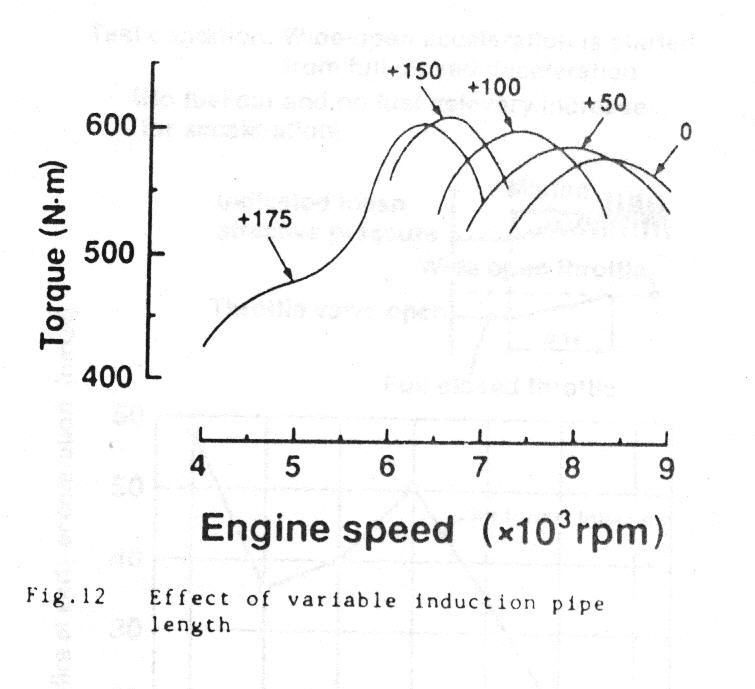
This chart is from an SAE paper by Mazda on the variable intake pipe
length of the Lemans winning 4 rotor engine and another one from Mazda
is what I base my intake pipe length  recommendations on. This is just
the movable portion of the intake pipes. You need to double this when
it is fully extended.

Also there is a small additional length where the pipe curves and goes
into the rotor housing. This is for a 1.75 to 2 inch pipe diameter.
175 mm is 6.88 inches so when it says 175 the total length of
stright pipe is 13.8" Add to that another six inches or so for the
curved section and the throttle body and you come up with about
20 inches for 6000 to 6500 RPM. I think Everett found about
24 inches worked well.

These are both normally aspirated peripheral port engines of course.

BTW I think a newton or N in this chart is = to one kilo or 2.2 pounds.
A meter of course is 3.28 feet so to convert to foot pounds
multiply N-Meters  by 2.2 and  divide by 3.28 to get foot pounds.
At least I think this is the proper conversion!

So 600 N-Meters would be about 402 ft pounds or 100 foot
pounds per rotor or about 200 foot pounds for a two rotor.

Converting 200 ft # to HP at 6000 RPM I get about 228 HP normally
aspirated with a 1.75 to 2 inch diameter 20 inch long
intake pipe for a two rotor. The formula I used to convert to HP is
torque times RPM divided by 5252. I think that is the right
constant as I recall.

If I were building a NA rotary aircraft engine with a 2.17:1 PSRU
this is what I would start with. I would not mess with a side
port engine.

intakel.jpg

Paul Lamar

The Aircraft Rotary Engine Newsletter.              Powered by Linux.

http://home.earthlink.net/~rotaryeng/            http://www.linux.org