Jeff Spitzer wrote:
Brian D. Cain wrote:
I've been told that the 3mm steels 'chatter' up against rotor housings
at high RPM's although I've seen a few of the hard-core racer-types running
a gajillion RPM's using them.  Ray Lochhead of Shane Racing, however, runs
2mm stock jobbers on a 600+hp output, 9sec drag car.  So, I'm still
scratching my head over this.
What's the scoop between the differences, for the record? I'd like to
see some numbers if anyone's got anything available like that.
B
Here's my $.02 from a purely engineering standpoint with NO empirical data
to back it up:
1) You cannot damage 2mm steel apex seals with any amount
of boost
The Mazda 2 mm seals are not steel. They are hard cast iron and they
will fracture under detonation.
2) Lighter apex seals will always give better trochoid life at
high continuous RPM
This I agree with.

3) Thicker seals do not seal better due to thickness
alone...only a design or fit change will seal better.
This too I agree with. In fact I will go out on a limb
and state 2 mm seals seal better at low speeds.

4) Who said bigger was better?
Jeff Spitzer
Me.

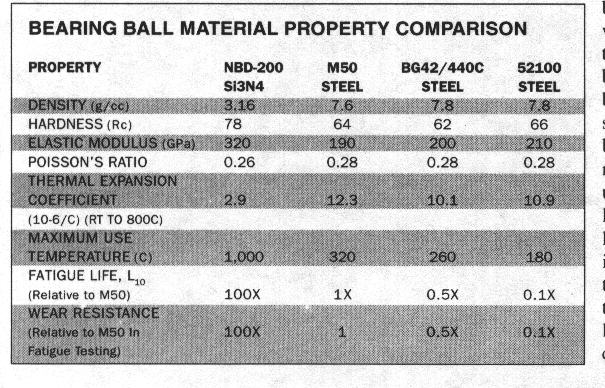
Here are the engineering specs on silicon nitride seal material.
Note the half density. The 3 mm silicon nitride seal is lighter
than the 2 mm cast iron.

Paul

The Aircraft Rotary Engine Newsletter.              Powered by Linux.

http://home.earthlink.net/~rotaryeng/            http://www.linux.org