Bill Freeman wrote:
Paul,

You getting sick of this idea?  One more time.  .  .  .  .

Final cut and then I'll leave it to the "them that's doin'"
as opposed to "them that's talkin' about it".   If anyone
wants more info to * actually try* this system, I'll help out
otherwise, I'll drop it.

Seems that putting a lube oil tank on the firewall and
installing a sight gauge tube at the extreme left edge
of the instrument panel, and keeping the tank cross section
such that an hour's burn of oil would be at least a 1/2" move
in the sight gauge would provide a pretty reliable indication
of proper engine lubrication, and yet avoid the (admittedly
minor) hassle of mixing oil with the gas.

A shutoff valve in the oil feed line would be a nice thing,
but may not be necessary since the oil and gas may  have
similar enough densities so that the oil won't flow without
fuel flowing thru the metering venturi to provide suction.

OK, done with this idea.  May fall into the category of
"an ingenious solution to a non-existant problem".

Bill
Based on 277 cubic inches per gallon and  128 ounces per
gallon I figure one ounces is about 0.46 cubic inches.

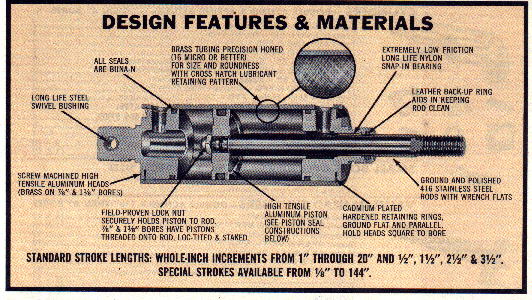
This is an air cylinder by Allenair Corp but it should
work fine with low pressure oil. Allenair's address
is 255 East Second Street Mineola, NY 11501
516 747 5450

A one inch diameter cylinder has an area of 0.78 square inches
so about a stroke of about 0.60  of an inch per
ounce would be about right. That means a total stroke
of 3 inches would give you about five ounces. Sixty gallons
of fuel would then reqire 12 strokes. You are not likely to put
less than 5 gallons in your tank anyway.

Check my numbers because I am known for making stupid
mistakes.

All you need now is a T and a couple of ball check valves
to build yourself a "primer" type oil pump that will
pump oil into the fuel tanks.  Waggle the wings and
kick the rudder to mix throughly.

alaircyl.jpg

Paul Lamar

The Aircraft Rotary Engine Newsletter.              Powered by Linux.

http://home.earthlink.net/~rotaryeng/            http://www.linux.org