JMLBlues@aol.com wrote:
In a supercharged application, we have seen this dramatic power fall-off
after only about 10 minutes at WOT. This was a lightly-supercharged engine,
about 205 hp at 6000 rpm. The engine would continue to run at, say, 70% power
(a guesstimate). Each successive attempt at WOT would acheive full power for
a shorter period. After about three tries, the engine just wouldn't pull to
speed. We haven't had the opportunity to see what happens
naturally-aspirated, I would suspect a similar phenomenon, only taking
somewhat longer to get there. The problem is that there is essentially no
warning -- the engine is running fine and then it just tries to quit.

In my previous life working on military diesel fueled rotaries, we saw very
similar problems that had a number of causes, seal lubrication being a
prominent factor.
Very interesting Jon. I wonder what affect seal material and rotor
housing plating type has on this  phenomenon? Was that a supercharged
Mazda rotary?

Jim Mederer of Racing Beat told me to also think about how flat
the housing is at high power levels. It is essential to be sure
the housing is designed to remain flat as it is heated and to
provide enough cooling to insure it does not over heat and
warp.

I also suspect the apex seals were warping due to over heating
and the bi-metalic bending effect. Did the engine recover
some what  after it cooled off?

I suspect the very low coefficient of thermal expansion of SiNi ceramic
seals would reduce this phenomenon greatly.

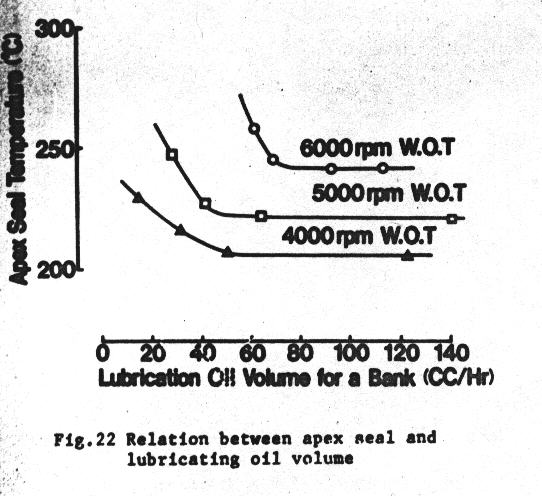
The chart is from a Mazda SAE paper on the subject.

sealtemp.jpg

You are a wealth of information Jon and a great asset to this newletter.
We are very lucky to have you commenting on here.

Paul Lamar

The Aircraft Rotary Engine Newsletter.              Powered by Linux.

http://home.earthlink.net/~rotaryeng/            http://www.linux.org