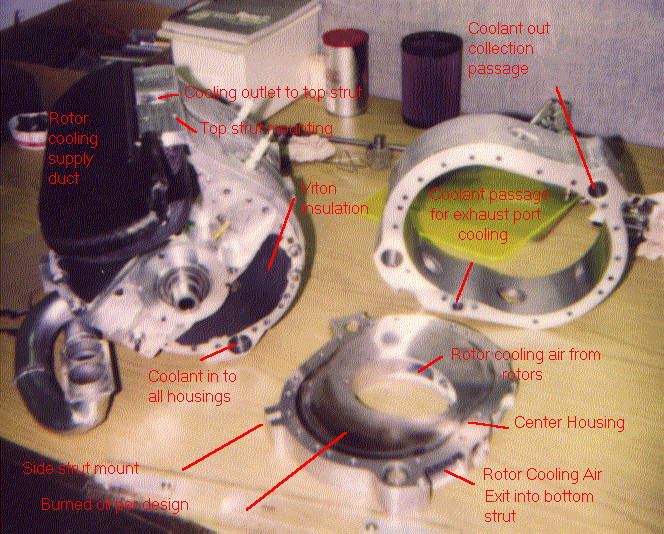
Jeff Spitzer wrote:
Sorry Paul, It's you who has it wrong.  Don't forget I've actually designed
one of these suckers from scratch.  If you look closely at the attached
picture you'll see that the ribs that support the main bearing are at about
10-15 deg.  (I can't remember the exact number) from the minor axis.
That's because the load is always and only high in that direction.  The
derivation of why is left to the reader.  (I love saying that 'cause it
always pisses me off when they put that in textbooks :) Notice that the
ribs line up exactly with the *main* bearing loads shown on your chart.  No
mistake here.

Jeff Spitzer
I think you are still missing it Jeff. Yes the main bearing loads
are always at the same angle as they are due to combustion
forces only. The lower chart shows no direction. It is only
a function of e shaft RPM. It is therefore a chart of ROTOR
BEARING loads and not main bearing loads.
OK I will OCR scan the text from the book for you.
3.4.3 BEARINGS AND BEARING LOADS
For the main and rotor bearings in small sized
engines, ball and roller bearings are mostly used.
For automobile engines to be operated over a wide
range of revolutions under severe load conditions, plain
bearings of babbit metal or aluminum alloy are general-
ly used, as shown in Fig. 3.1.
Fig. 3.25 shows the characteristics of load on the
main bearing of a rotary engine.
In the rotary engine, the inertia force of its mov-
mg parts can be completely balanced. The load acting
on the main bearing is fundamentally only the element
in the center direction of the burne4 gas pressure applied
on the rotor.
On the rotor bearing, the burned gas pressure ap-
plied on the rotor and centrifugal force caused by the
planetary motion of the rotor will be applied.
Since these two forces act nearly in opposition
to each other, the load on the rotor bearing to the
engine speed has characteristics as shown in Fig. 3.26.
This graph has been prepared by plotting the
maximum value of bearing loads at each engine speed
specified, indication that the greater effect of gas
pressure in the low speed range and that of
centrifugal force in the high speed range are apparent.�
End of quote.
IMHO your huge ego is what makes you such a brilliant young
engineer Jeff. One of my pet theories. I like it in an
engineer :-)
Jeffs-Moller11-parts.jpg
Paul Lamar
The Aircraft Rotary Engine Newsletter. Powered by Linux.
http://home.earthlink.net/~rotaryeng/ http://www.linux.org