There is another subtle drawback to a supercharger
compared to a turbo charger. If the super is driven from
the nose of the e-shaft you have a large bending load
on the front of the e-shaft that reverses once per revolution.

At 5000 RPM or 300,000 rev. per hour it don't take long to
get up to fatique cycle numbers. That is only 33 hours
for 10,000,000 cycles by my calculations.

The end of the shaft is 3 inches from the front main
bearing so if the side load is on the order of
1000 pounds that is a moment of 3000 inch pounds
on a shaft that is about 1 3/16 inch in dia.

I will leave it as an exercise for the student to
calculate the bending and combined torque stress
on the shaft :-)

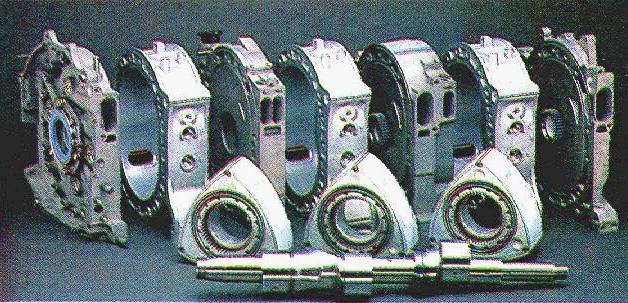
BTW the three rotor would be worse as number one;
you need more HP to drive a bigger blower. Number two;
the shaft sticks out further I think. Number three;
it is the same size as the two rotor shaft.

You can fix this of course by providing an outboard
bearing much as what is done with a belt or chain
PSRU.
With difficulty in alignment I might add.


3rot-parts.jpg

BTW the alternator and water pump are only half a
dozen HP total while a super can be as much as 50
HP if you are wondering about the side load from
those devices.

Paul Lamar

The Aircraft Rotary Engine Newsletter.              Powered by Linux.

http://home.earthlink.net/~rotaryeng/            http://www.linux.org