JMLBlues@aol.com wrote:
The 22 hp figure is from the performance data supplied by the supercharger
manufacturer. Crank speed is 6500 rpm at that point, for a torque of just
under 18 ft-lb. I dont remember the pulley diameter off hand, but its about
4.5 inches. So the applied force to cause bending is 96 lbs. (its late, check
my math and my reasoning). Add the static load from the belt tension --
figure 125 lbs x 2 assuming worst case of 180 degree belt wrap (its too late
for trig -- lets use some simplifying assumptions). Total load on the crank
is then 346 lbs. Frankly, I'm not all that concerned. (But I haven't
calculated the stresses either). We don't use air conditioning, power
steering, or air pumps which all add bending moments to the crank. Also, our
supercharger drive pulley is fairly close-in to the front cover. Note that
the A/C pulley on an RX-7 is pretty far away from the main bearing, and the
AC is probably capable of almost as much power absorbtion as the supercharger.

I'd like to comment on an earlier thread about exhaust energy being "free."
For turbochargers or turbocompounding strategies, the turbine is driven by
the exhaust enthalpy, which is a kind of combination of pressure and thermal
energy. (Its been too long since I took thermodynamics...) My gut feel is
that most of what drives the turbine is the pressure element. The turbo will
apply appreciable back pressure to the engine. While this may be mitigated by
some kind of favorable intake charging dynamic effects because of the port
timing, there is certainly a loss involved.
Chuck_Harbert@arkwright.com wrote:
Paul, when we used to race blown motors, I thought we we're using about a third
of the engine hp to turn the blower at high boost (30psi). We made about 1,500
hp, but we actually calculated we were making over 2,000, but the roots blower
was taking 500+hp.

Thus, this sounds to good to be true (22hp for 260hp). Maybe this at low
rpm/boost? I always thought the hp reqd was closely related to the rpm/boost
pressure developed. For 260hp, this is about 6.5 psi according to Paul Yaws dyno
results.

Paul, you're good at the numbers, so let's see what you can calculate.
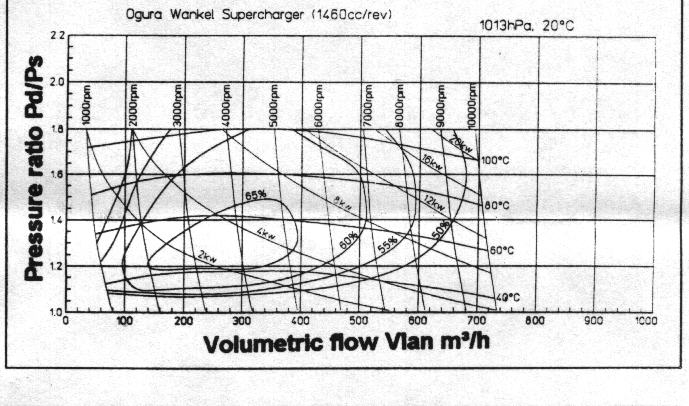
Here is the chart for a Wankel gmbh/Ogura brand rootes.

Can you calculate the HP from this information? Jeff is good at this
sort of thing. Wankel gmbh claims theirs is more efficient than the
Eaton.

Paul Lamar

The Aircraft Rotary Engine Newsletter.              Powered by Linux.

http://home.earthlink.net/~rotaryeng/            http://www.linux.org