Perry Mick wrote:
Paul wrote:
It occured to me Perry that an some sort of inflatable lip around
the duct entrance  would improve the low speed thrust and could be
deflated to reduce the high speed drag.
I've been thinking about this, but I think you're trying to solve
a problem that doesn't exit.  If the duct is designed for 200mph,
but I'm seeing improved static thrust and low speed operation with
the duct versus no duct, then there is no reason for this.

I think those types of problems show up when you are trying to operate
over a 0 - 500 mph range, not the 0 - 200 mph range we're dealing with.

Perry
The dynamic pressure at 200 MPH is about 104 pounds per square foot.
If you have an additional frontal area of the duct three inches
thick and an average diameter of 40 inches I get an additional
frontal area of 377 square inches or 2.618 square feet.
Times 104 pounds per sq/ft is 272 pounds of drag at a
drag coeff of one.

At a drag coeff of 0.1 it would be 27 pounds of drag.
At 200 MPH or 293 FPS the HP would be 7920 pound/foot-per-second.

Dividing by one HP or 550 pound/foot-per-second gives
a 14 HP loss. This is probably an optimistic estimate of
your duct loss at 200 MPH. This does not include a skin friction
loss due to high slip stream velocities within the duct.

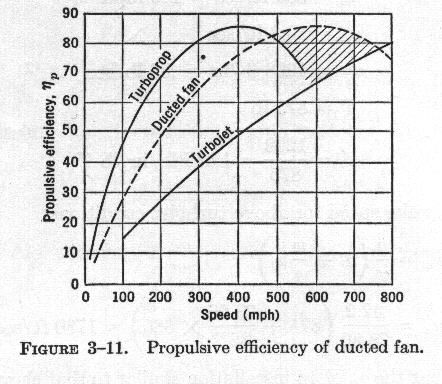
The attached chart is from Perkins & Hage Airplane Performance
Stability and Control Page 133. There are many such charts in the
aircraft design technical literature.

The whole situation is very interesting to me and I await your flight
test results. I myself have designed a ducted fan airplane and I came
to the same conclusion as  F. Marc de Piolenc in his ducted fan  book.

http://www89.pair.com/techinfo/MassFlow/ductbook.htm

Specificaly to make it work for a  practical cross country airplane you
need a lot of excess power. A turbo charged rotary is
indicated. The Racing Beat turbo charged three rotor ducted fan
project is taking that approach with 1800 HP total available.

I don't say all this to discourage you Perry. I think what you are
doing is going to add to our knowledge on this subject and I
am very glad you are doing it. It is important that people try
old ideas from time to time to verify that the application of
some new tech has not changed the situation for the better.

I would suggest you plot the acceleration of the airplane as
function of distance so we can be sure by extrapolating
the rate of change of acceleration that the airplane
will fly well.

 ducvprop.jpg

Paul Lamar

The Aircraft Rotary Engine Newsletter.              Powered by Linux.

http://home.earthlink.net/~rotaryeng/            http://www.linux.org