Archie Frangoudis wrote:
It is my impression, from what I have read, that this is a new
engine design. Is this correct?
Archie
Most of this is from SAE paper 950454 on the side port engine.

Mazda found that the fuel consumption at the lean limit was
drastically affected by the CO2 concentration in the mixture.
Reducing the CO2 from 3.0% to 2.5 % resulted in about a
one percent improvement in the fuel consumption. This is commonly
called EGR. They found that EGR decreased with the reduction
of overlap. No surprise there. The best compromise turned out
to be side exhaust ports with:

exhaust open at 50 degrees BBDC
exhaust close at 23 degrees BTDC
intake open at 32 ATDC
intake close at 80 ABDC.

BBDC before bottom dead center
BTDC before top dead center
ATDC after top dead center
ABDC after bottom dead center.

The old peripheral exhaust engine was:
exhaust open 75 BBDC
exhaust closed 48 ATDC
intake open 32 BTDC
intake closed 80 ABDC

Needless to say the EGR was reduced and the engine could
be run leaner with better low power BSFC.

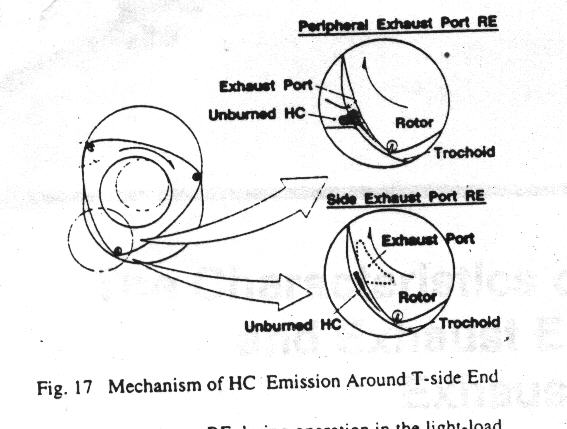
Instead of the unburned hydro carbons being swept out
the peripheral exhaust port they are trapped in the side
exhaust port engine and carried around to be burned
in the next cycle. See the picture below. sideexha.jpg

There are a few less obvious advantages to the side exhaust port.
If an apex seal does fracture the parts are more likely to stay
in the rotor slot and not jam the rotor with the housing.
That does not stop the engine of course but it  does chew
up the rotor housing and rotor slots.

So that appears to be a durability advantage.

Mazda is always fighting the emmisions and BSFC at low HP levels
typical of automotive operation. Much of their engineering
is driven by these concerns. What works
in this range is not always the best  in the range of
an aircraft engine. What has been great however is the
inter-change-abilty of the parts to allow one to taylor
the engine to one's needs. For example peripheral
intakes and exhaust for high power at 6000 RPM.

In the automotive world higher RPM appears to have become
more acceptable to the average driver. In the old days
torque was king. No replacement for displacement.

I think most aircraft rotary engine applications could
benefit from a higher PSRU ratio than the common and
popular 2.17:1. Higher RPM within reason has little
affect on the life of the rotary engine.

IMHO torque is still king around town. Nothing like
that low speed kick in the pants you get from a big
block away from the stop light.

sideexha.jpg

Paul Lamar

The Aircraft Rotary Engine Newsletter.              Powered by Linux.

http://home.earthlink.net/~rotaryeng/            http://www.linux.org