Paul Yaw wrote:
I perform this mod on nearly every engine that I build.  I got the idea
from the Racing Beat catalog.  My understanding (Or possibly lack of.)
is that two things happen.  The surface area is increased, and a great
deal of turbulence is created.  I know that the increased surface area
will help, and based on what I have read, I assume that the turbulence
will also help. Sort of like the "wavy" wires in the stock Mazda oil
cooler which for its size, outperforms almost everything else.  I do
this for three reasons.

1.  I intend to minimize distortion of the rotor housing surface in the
plug area.  If you look at the wear on a used engine, you will find that
the hot area around the plugs shows the greatest wear.  I assume that
this is caused by distortion. (That area getting really hot, and
protruding.)  I had the opportunity to disassemble an engine that was
tuned on the dyno (Approx 30 full power passes.) and then severely
overheated during about twenty laps on the track.  The area around the
spark plug holes had worn to a nice shiny finish, while the rest of the
rotor housing still retained the dull finish that a new rotor housing
has.

2.  I want to keep that area cool enough to avoid burning the
lubricating oil.  It is common to find burned oil caked on the rotor
housing surface near the spark plugs, and the exhaust port.

3.  I contend that the apex seals are cooled through their contact with
the rotor housing which is water cooled.  For this reason, I want to
avoid hot spots on the housing surface.  My contention is that
increasing the premix oil does not COOL the apex seals.  It does however
allow them to run cooler because of reduced friction.
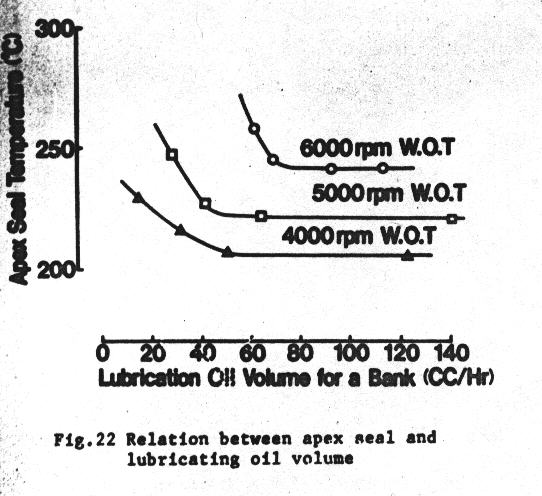
I think you are wrong about this Paul. I have several Mazda papers that
have measured apex seal temps as a function of the amount of
apex seal oil injected. The primary function of the oil is to
cool the seals. The lube film would limit the apex seal  heat
transfer anyway. The housing surface near the plugs is probably
almost as hot as the apex seal so there would be little heat
transfer. Housing surfaces run 180 C or  350 F while the apex seal is
as much as 500 degrees F at its center.  Right around the leading plug
holes
surface temps run 210 C or 410 F. This is without grooving. Two cycle
oil should handle that fine without coking. These numbers are WOT 6000
RPM. IMHO the coking is caused by injecting poor quality system oil.
Grooves can't hurt of course but they probably reduce the
BSFC slightly. PL  sealtemp.jpg
So, since I don't know anything about heat transfer, is there a better
way to cool this area?  Is there anything more that can be done?

I have noticed that engines which have been modified in this manner
color the spark plugs differently.  The ceramic will be slightly darker
in color which shows that more heat is being pulled into the water
jacket.

Now I wonder if something more can be done.  Any takers?

Also, Jeff Spitzer, could I get your e-mail address?  I would like to
ask you some questions about cavitation, and the stock water pump.

Paul Yaw
The Aircraft Rotary Engine Newsletter.              Powered by Linux.

http://home.earthlink.net/~rotaryeng/            http://www.linux.org