Paul Yaw wrote:
snip
3.  I contend that the apex seals are cooled through their contact with
the rotor housing which is water cooled.  For this reason, I want to
avoid hot spots on the housing surface.  My contention is that
increasing the premix oil does not COOL the apex seals.  It does however
allow them to run cooler because of reduced friction.
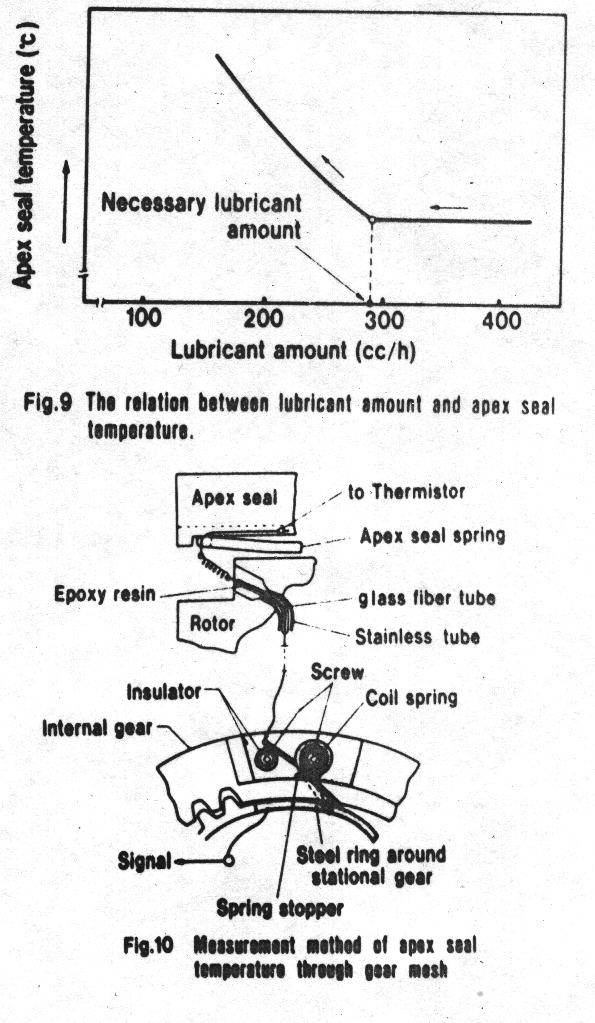
I think you are wrong about this Paul. I have several Mazda papers that
have measured apex seal temps as a function of the amount of
apex seal oil injected. The primary function of the oil is to
cool the seals.
Why would the oil, which is the same temperature as the gasoline, cool
the apex seals better than the gasoline itself would?  If anything,
dumping gasoline on a hot surface would cool it better than oil would.
As I see it, the only way that oil could cool the seals would be by
absorbing heat from the seal.  If that is the case, then gasoline alone
would do a better job.
That is a good question Paul that I don't know the answer to.
Perhaps the mixture being 12 times by weight of air to the fuel vapor
has something to do with it. Since I cannot afford to do the research
I am only going on what Mazda is saying. PL
The lube film would limit the apex seal heat
transfer anyway.
That's a good point.  I wonder what's going on there.

 The housing surface near the plugs is probably
almost as hot as the apex seal so there would be little heat
transfer. Housing surfaces run 180 C or  350 F while the apex seal is
as much as 500 degrees F at its center.  Right around the leading plug
holes
These numbers for the rotor housing surface vary a great deal according
to Mazda.  On the cool side of the chamber (intake side), they claim 90C
which is approximately thermostat temperature, and as much as 200C on
the hot side (combustion side)  I cannot imagine how they could measure
the temps of the apex seal while the engine is running, but if they can,
it represents the temp of the seal which is in contact with the water
cooled housing.
They did it with slips rings. This is from SAE 860560
Material Tech....Mazda ....  slipring.jpg PL
Combustion temps can exceed 2000F.  The rotor housings
only survive this because they are water cooled.  If the seals had no
contact with the rotor housing, which is much cooler, they would quickly
reach the combustion temperature. (Or close to it)  Imagine heating an
apex seal with a torch until it glows red, and then trying the same
thing with the apex seal pressed up against a rotor housing.  It would
take much longer to get the seal up to the same temp because much of the
heat would be transferred into the housing.  So I guess my point is that
the temperature differential that you stated is including the heat
transferred to the rotor housing.

If the apex seals were "floating" in the chamber, and could not tranfer
heat to the housing, they would not last more than a few minutes.  Now
if this were the case, what would cool them better, being doused with
cool oil, or cool gasoline?
I would not say "being doused with ..... cool gasoline?"
Perhaps "being doused with cool mixture" is more accurate.
See my comments above on this. PL

snip
Paul Yaw
The Aircraft Rotary Engine Newsletter.              Powered by Linux.

http://home.earthlink.net/~rotaryeng/            http://www.linux.org