Vance and Emily Jaqua wrote:
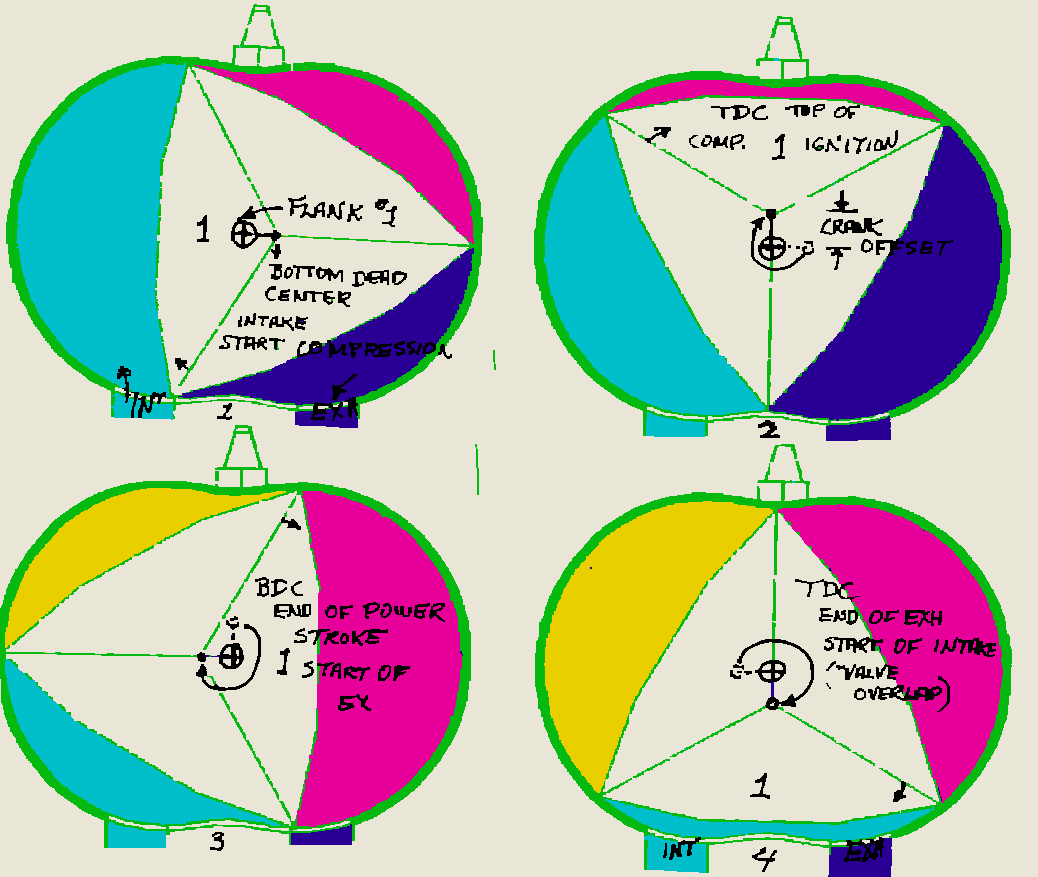
 Paul - attached are some figures from my Wankel
animation model. It shows the top and bottom dead
center for a selected rotor flank, taking it through
 the classic four stroke cycle in one full turn of
the trochoid, and 3 turns of the excentric [:-)] output
shaft.
Opps right here we have a problem. The engine goes through
the classic four stroke cycle in ONE 360 degree turn of the
eccentric shaft and ONE THIRD turn of the rotor.
This is the root cause of your mis-apprehension.
The effective stroke is twice the excentric
offset distance, the same as any engine with a crank
 shaft.
Sort of true.
Also, I feel strongly that a single lobe
displacement is this "stroke" times the projected
area of the flank face, and the total displacement
is three times this volume.
Definetly NOT true.

It is not a piston in a rectangular  cylinder. To calculate
the displacement you must calculate the crescent
max side area and multiply by the width of the rotor.

It completes its four cycles in ONE turn of
the eccentric shaft so it is like a two cycle piston engine
in that regard. Therefore the equavalent displacement
is just like a two cycle piston engine and is twice an
equvalent  four cycle piston engine. All motor vehicle racing
organizations all over the world recognise this displacement
equvalent. Not that displacement means a damn in an aircraft
engine.
The rotor sweeps this
total volume twice per rotor revolution the same as a 3 cylinder 4 > >  >stroke piston engine does in 2 revolutions.
The above is the part that is REALLY wrong.

The rest of this below is correct.
The orbital path of the  rotor CG
creates a one per output shaft rev shaking in both planes( actually   >all radial planes) which is easily
balanced by counter weights on the crank shaft for
even a single rotor. The two rotor configuration
is statically balanced but there is a longitudinal
rocking couple from dynamic unbalance, which is
 also easily balanced by opposing end counter
weights. From my analysis and modelling of the
Wankel mechanism, and over 40 years of professional
design and analysis of numerous type of heat engines
- that is my call on these questions - Vance
The Wankel mechanisim has fooled a lot of fine engineers
in its time :-) It took  me thirty years to understand it.
It took this newsletter and trying to explain it over and over
again to some of the 600 subscribers on here that had questions
about how it worked.

Paul Lamar

The Aircraft Rotary Engine Newsletter.              Powered by Linux.

http://home.earthlink.net/~rotaryeng/            http://www.linux.org