Vance and Emily Jaqua wrote:
 I really do like the Wankel, and think that it has
 a lot of potential as a bridge between piston
engines and turbines in General aviation. However
I have a lot of trouble with the almost religous
dispacement denial among rotory enthusiasts. It was
to Mazda"s advantage to perpetuate this confusion
since there is a high tax in Japan based on
displacement. I strongly contend that each rotor
is in effect a 3 cylinder engine module, and each
face displaces a volume that is the projected face
area times twice the offset distance of the
"eccentric "("stroke" in any similar form of crankshaft.)
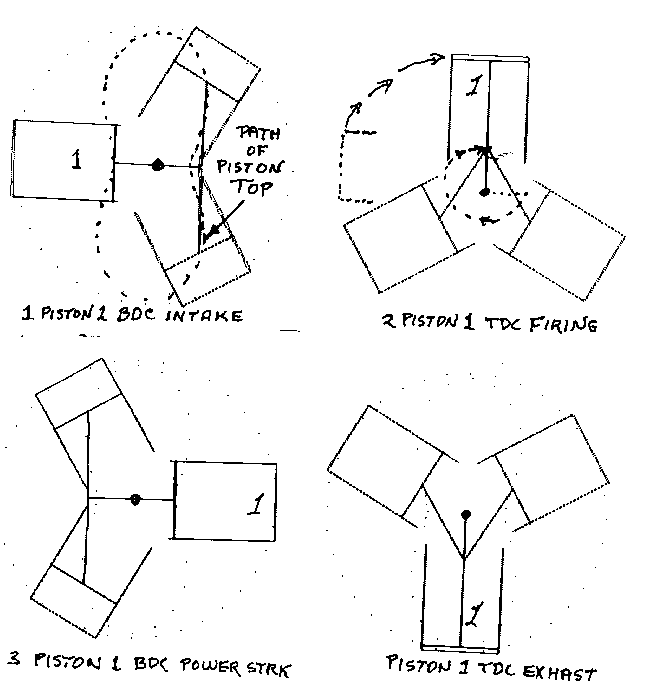
The first figure shows a typical rotor and housing
with one face at BDC of the intake stroke,
superimposed ids the side view of the volume at TDC
end of compression/ignition. The stroke distance is
also drawn in this area and shows that the volume
width is about 1 1/2 times this stroke for a strong
indication that this volume is indeed the size I
say - if you do this experiment by filling the
tha chambers with calibrated liquid you should
get this same answer. Since we have three such
"pistons" the displacement of each rotor system
is 3 times this value.
The secomd picture shows the actions of a 3 cylinder
rotory piston engine in the "Gnome" tradition, but
we shall rotate the crankshaft 3 times as fast as
the cylinders, in the same direction.
With some error due to rod angle, this is almost a perfect
analog in air handling and thermodynamics as the
Wankel. The path of the top of the piston is very
much the obverse of the Wankel housing, and that
is not an accident. Now I am sure you have no
quarrel with the displacement of this engine being
three times the swept volume of each "barrel".
Like you said " the Wankel has confused some very
good engineers. -Vance
If it was indeed three pistons and the rotor did indeed
rotate at output shaft speed then it would indeed be
equavalent to a three cylinder two cycle engine and
it would put out three power pulse per piston/rotor-top
per rev.

If it was a four cycle engine it would put out one and
a half power pulse per rev.

Unfortunately the rotor is geared down and runs at only
one third eccentric shaft speed and therefor there  is only
one power pulse per eccentric shaft rev. The same as
a two cycle engine.

If you tax engines only on "displacement" then two cycle engines
would dominate since they have twice the number of power
pulses as a four stroke engine with the same "displacement"

BTW I think taxing engines on displacement is stupid. IMHO it leads
to bad engineering decisions such as high reving engines with
double over head cams and four valves per cylinder. That does
not neccessarily lead to the highest power to weight ratio
engine. The typical horzontal opposed aircooled aircraft engine
is a good example. Even a rotary, with all the neccessary accessories
such as rads and PSRU's, is hard pressed to equal the power to weight
ratio  of an aircooled aircraft piston engine.

Now suppose there was such a thing as a one cycle engine with
with one chamber and two power pulses per rev. What then?

Two cycle engines have one chamber volume explosion per output
shaft rev. The same as a rotary engine. So in this sense it
is the same as a two cycle engine. Do they double the displacement
tax in Japan for two cycle engines? They do indeed double the
displacement
of one chamber on rotaries for tax purposes  as they are considered
the same as a two cycle engine. This is  as it should be.

Racing organizations around the world agree and do the same thing
as far as equating rotary engine displacement to four cycle piston
engines.
Unlike a two cycle engine it does indeed really put out twice the
power or more. The best a two cycle engine can do is roughly 75% more
plus or minus 10%.

The geometric definition of displacement is the max volume
of a chamber. Period!

The real definition of equivalent displacement in the context of an
internal combustion engine is: how many max size chamber
volumes subsequently compressed  explode in one output shaft rev.
Not the number of piston/rotor tops times the stroke.

Paul Lamar

Vance-Jaqua-wankel2.gif

The Aircraft Rotary Engine Newsletter.              Powered by Linux.

http://home.earthlink.net/~rotaryeng/            http://www.linux.org