F. Marc de Piolenc wrote:
Paul wrote:
In this photo it is evident that you are losing thrust due
to the low pressure area in front of the duct acting on the
downsloping top of the cowling.
In any stern-propulsion scheme, there will always be a small drag
increment (or thrust deficit, if you prefer) due to an induced lower
pressure on the aft body, PROVIDED that there wasn't separation there
before the propulsor was installed. If the propulsor keeps flow attached
when it would not be otherwise, then it may cause a net drag REDUCTION
compared with bare-body flow.
The duct is definetly biased toward low speed thrust IMHO.
Respectfully disagree. Exit area is the key, and that shows that it is
sized for cruise. A low-speed duct would have an expanding exit tract.

Marc de Piolenc
Mass Flow
http://www89.pair.com/techinfo/MassFlow/massflow.htm
Possible. If there is a low pressure area on that down
sloping panel than there will be a drag component due to
the rearward facing pressure vector. My point is: it is better
to get rid of or minimise the panel.

I base my speed contention on the radius of the inlet lip.
At high speeds this lip will cause more drag than
a lip of smaller radius and lower outside duct diameter
such like an airliner duct.

The minimum drag configuration would be no duct at all.
No skin friction drag no form drag. The duct would have
lower form drag at high speeds with a smaller radius lip
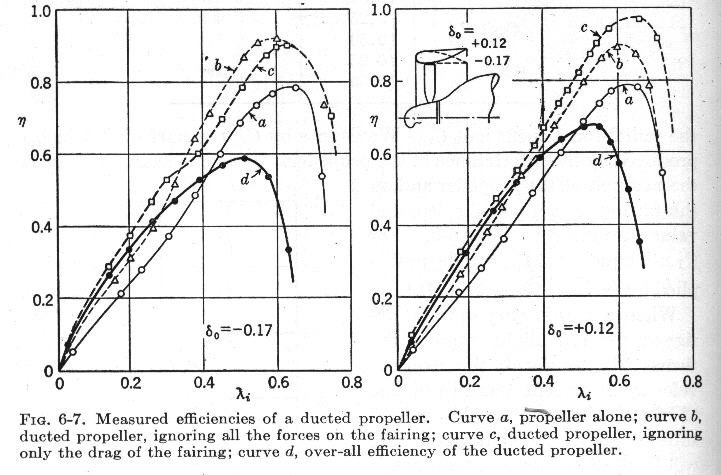
and outside diameter. Here is a chart on the subject from
Kuchemann and Weber Aerodynamics of Propulsion.

ductfan1.jpg

Perry has yet to test a small diameter propellor at high speeds
without a duct compared to the same diameter prop with a duct.
Kuchemann and Weber maintain the duct (d) is better at low speeds
while the unducted prop (a) is better at high speeds. Both
being pitch optimised for advance ratio of course. Curve (d)
takes into consideration the drag of the duct.

The data is given in internal rate of advance so there must be
an adjustment in prop pitch with and without the duct according
to the chart. So far Perry has not tested this scenario. He has
tried the same pitch prop with and without the duct at low advance
ratios and found the duct to be better as to be expected and as
also shown in the chart.

I really hope this works as it is lower cost and probably lighter
weight than a PSRU. I am just trying to widen its effectiveness
by focusing on configurations that will achieve this end.
Namely streamlining the fuselage ahead of the duct and reducing
the transonic drag of the fan tips. With a Clark Y airfoil at
0.7 mach there probably exist a shock wave on the top surface.

I also think it it better to sacrifice some low speed acceleration
(thrust) for higher efficiency at cruise speeds.

BTW Perry how does this Sunday afternoon  June 20th
Fathers Day sound for my visit? My appointment with Continental
to get my brand new O-470 crank checked for cracks is this
coming Thursady the 24th :-(.

Paul Lamar

The Aircraft Rotary Engine Newsletter.              Powered by Linux.

http://home.earthlink.net/~rotaryeng/            http://www.linux.org