Vance and Emily Jaqua wrote:
First - I agree that using displacement for tax
puposes is dumb (tho not quite as dumb as the prewar
English system of RAC HP which only used piston
area - also early USA license power that did the
same thing.
Using output shaft as an indicator of displacement
is also dumb - because then you would rate the
 Dynacam engine at twice the real displacement since
the shaft turns once for the total four strokes
of the Otto cycle, as well as the same thing for
the il fated Tiara class from Continental where
the output was taken off the cam drive, and Merlins
with integral reduction drives - ad infinatum.
OK let's define the output shaft as the one the
connecting rods or rotor are attached too.....
not the prop shaft. Let us leave the Dynacam out of
it for the moment. In the case of the Tiara (and other
like engines) the cam shaft gears just happened to serve
dual purposes one of which was the PSRU. Almost
all late model large radial engines had PSRU's and there
was nothing "integral" about the PSRU on the Merlin.

Paul Yaw's statement about the amount of air it can
pump in one rev of the output shaft is still the best
definition of "displacement" I have seen on here yet.
A
positive displacement heat engine swept volume is
primarily taken as the total of the working chambers
for one fill and empty, for either 4 stroke or 2
 stroke engines. This does give an advantage to
the two stroke, which is often controlled by
arbitrated rules.
The Wankel is in no way related
to a two stroke engine, and the classic 2 rotor
design has six working chambers.
I totally disagree with this as it has the same number
of power strokes per rev of the output shaft as defined
above. As a two stroke it is also consistent with Paul
Yaw's definition. And it does not have six "working"
chambers either.
They may not be
cylinders, but they act the same way, and all three
chambers are filled and emptied twice per each rotor
full revolution resulting in three four stroke
power "strokes" in each rotor chamber system.
So what and not true? See the definition of the output
shaft above? You can not get mechanical power out of the
rotor directly with the type of Wankel we are talking
about here.
The
fact that the output shaft is turned 3 times by the
 eccentric path (not gears) does not relate to the
displacement
What do you mean by "the output shaft is turned 3 times by the
eccentric path"? The eccentric shaft does not have a path.
It rotates. Perhaps you mean the center of the eccentric
on the output shaft.  The rotor/eccentric center has a circular path
about the the center of the output shaft. This path is
only followed once in one revolution of the output
shaft. I can't help but think, when reading this, you don't
really understand how the Mazda 13B type Wankel functions.
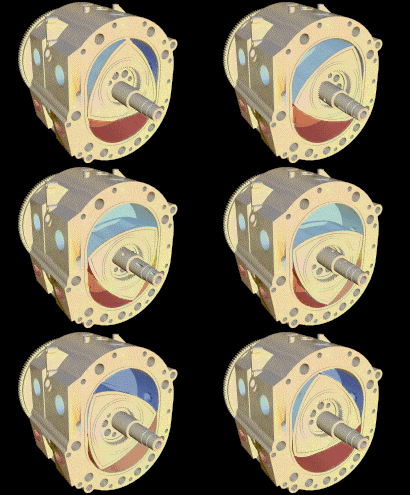
Again see the animation below.

If it is what I think you mean it has everything to do with it.
The rotor rotates only 120 degrees (one chambers worth) in
one 360 degree rotation of the only shaft you can get
mechanical power out of. In fact this is the one and
only shaft this type Wankel has.
- you would have no problem accepting
this fact if those were cylinders - so dont be
intimidated by tha wobbling trochoid.
I have a problem with it :-) BTW the trochoid
does not wobble. It stays still. The rotor
orbits. See the animation below.
Mazda had a vested interest in under stating true
swept volume (Taxes) and racing classes would be
giving an unfair advantage to the Wankel if they
Bought the story, and a disadvantage if they
truly rated it so an arbitrated number was accepted.
Vance
Give it up Vance! You are out numbered :-). Nobody is going
to rate the 13B at 3.9 liters. As Paul Yaw says, a normally
aspirated 1.3 liter 13B Mazda rotary puts out about the same
amount of power as a 2.6 liter four stroke or 1.3 liter two stroke
piston engine at about the same RPM  both suitable tweeked.

Paul Lamar

The Aircraft Rotary Engine Newsletter.              Powered by Linux.

http://home.earthlink.net/~rotaryeng/            http://www.linux.org