Perry Mick wrote:
Jeff Spitzer wrote:
Perry Mick wrote:
Sounds like you've had some "hands on" experiences with these things.
Can you tell us more about what you did, problems you had.
I designed several ducted fan propulsion systems while at Moller.  I'm
sorry to say that I don't see a lot of study or forethought in your
aerodynamic design. The engine is blocking way too much of the "fan".  The
fan is not a fan but a propeller.  The efficiency of a ducted fan is HIGHLY
dependent on uniform inflow.  You will not obtain uniform inflow with your
small hub radius and large bumps. Every ducted fan designer faces the same
problem.  The best compromise is to use a large ratio hub.  I'm not up to
speed on the aero of the fan but I believe there is actually a "best" point
at around 50%-60% hub to tip radius.
<snipped>
 It's obvious from your post Jeff that you have a lot more
experience with these things than I do, and I'm going to have to
digest most of what you wrote in this post and the previous one,
for awhile, but I'll make this short but quick response.

Even in Marc's book he calls what I've done a "shrouded
propeller", so maybe that would be a better term for what I've
built than "ducted fan".  I think some of what you wrote applies
more to "true ducted fans".  Mine probably still is operating
more like a propeller.

I have no doubt what you wrote is correct, but I still have one
problem with the "conventional wisdom": Everybody seems to say
the ducts are great at low speed (boats?) or high speed
(passenger jets), but not in the middle (where we are).
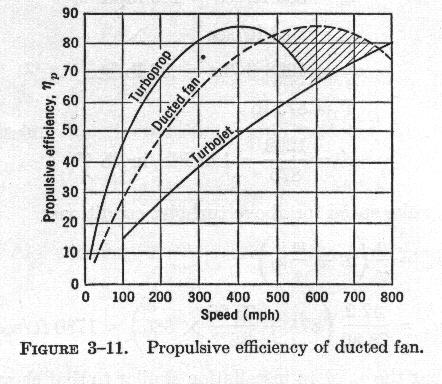
A wee bit of clarification here they work well at low speed
with a large lip. And at high subsonic speeds with a small lip
they are better than a prop.
See the chart below. ducvprop.jpg This chart does not show
the big lip configuration that works well at very low speeds.
PL
I'm not
an aeronautical engineer (obviously) but I think, according to
Marc, a duct will operate most efficiently at one airspeed.  If
you design it for that speed (cruise) that is the best you can
do.  That is what I did here.  The big lip would not be so big
and "low speed looking", if it weren't for the "big bumps" in
the way.  I've been able to get to 90 knots on the ground
easily, and that was with my duct still in the rough (unsanded
filler plastered all over it), so I'm pretty sure it will get me
in the air. Perhaps once in the air, the data will be
disappointing.

By the way, since you worked on them, are these Moller fans
really going to work? They are probably "true ducted fans" as
compared to what I've done. They are powered by rotaries also.
Even I doubt they will work as well as Moller's propaganda.  I
can understand how that 4 duct model works, but how is that 2
duct model controlled in pitch?  Seems like it would just "fall
over" forward or backward without a third or fourth "pedestal"
to stand on (during vertical takeoff). Are they routing thrust
from those two pods to some third location?

Perry

The Aircraft Rotary Engine Newsletter.              Powered by Linux.

http://home.earthlink.net/~rotaryeng/            http://www.linux.org