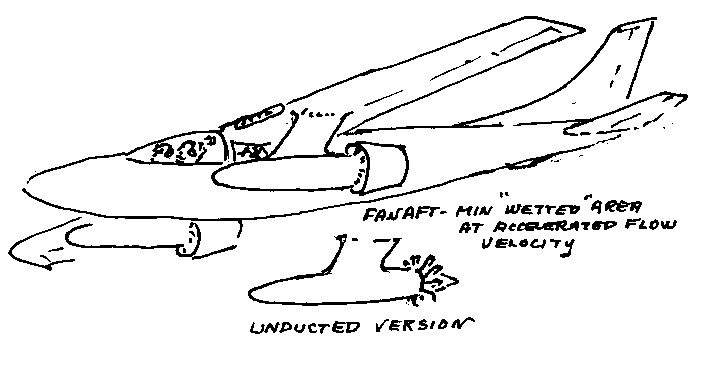
I kind of slept on your design Vance and decided it has
merit over my design.

First; the bending loads on the spar
are less but we don't want to get those engines too far
out there for (perish the thought) engine out controlabilty
reasons.

Second; the fuel feed can be gravity just like a
Cessna.

Third; the coolant will need to go up the pylon
so the engine will have a nice coolant pressure head.

One down side is we will have to put the intercooler in
the engine cowling which may require a custom round
intercooler which may be hard to make. Perhaps the way to
do it is use a separate liquid cooled intercooler the
way RR did it on the Merlin engine. Yes! That sounds like the
answer there. The large turbo charger required will have
to exhaust ahead of the engine like a PT6.

The rads can still be in the fuselage so we will need to
pump the hot water there and cool water back. Perhaps a little
de-icing, while we are at it, is in order. We can make
the leading edges welded aluminum surface radiators bolted to
the carbon composite wing structure. Similar to the
early P38 intercoolers. They can be built like heat
exchangers in refrigerators with furnace brazed
aluminum channels.

They can also double as fuel tanks with a fuel cooler
heat exchanger before the fuel goes into the fuel
injection system.

Easy to service.

Engine cooling on taxi and climb out would be easy as
the fuel  would act as a monster heat sink. Maybe I
should apply for a patent on that idea :-) What do
you think?

These surface radiators probably will not do the
cooling trick by themselves so we will need aux
radiators in the fuselage not to mention cabin heaters.

The oil coolers can be in the leading edge of the
pylons using stock Mazda turbo engine oil coolers.

Should we be looking at swept back wings?

Paul Lamar

The Aircraft Rotary Engine Newsletter.              Powered by Linux.

http://home.earthlink.net/~rotaryeng/            http://www.linux.org