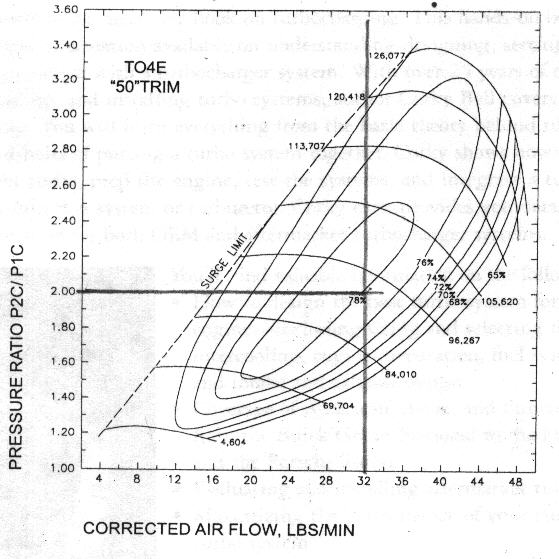
This is my reasoning on my turbo set up.

The chart is for a TO4E "50" trim.
The max boost is 15 psi at sea level with a pressure
ratio of 2:1. The 2.6 L 13B, according to a chart
in Turbonetics catalog, will use 32 lbs of air a minute
at a 15 psi boost at 6000 RPM at sea level.

At 12:1 air fuel ratio that is 2.6 pounds of fuel
per minute or 156 pounds per hour. At a BSFC
of .5 that is 312 HP. I think this is a rather low
estimate for 15 psi boost at 6000 RPM  but what
the heck lets go with it.

Let us say it is 400 HP. So I set the throttle
aprox one one half of the way open or about
200 HP and take off. At this time I do
not know what the manifold abs pressure or boost
would be. As I go down the runway I would
not be a bit surprised if the boost increased
slightly as the prop unloaded somewhat and the
engine RPM increased.

I gradually open the throttle to keep the
manifold pressure the same as I climb and at
30,000 feet the air density has fallen from
about .0019 pounds per cubic feet at sea level
to .0011 at 30,000 feet. At this point
I would need a pressure ratio of only 1.72 to
maintain sea level pressure. This appears to
be a peice of cake for this turbo. A max
pressure ratio of 3:1 appears to be
available.

As the RPM and air flow requirements of the
engine is reduced the operating
point of the turbo moves into a higher eff.
range of the turbo air flow chart.

Note: The RPM of the turbo started
out at only 80,000 or so and I have 126,000
to work with. I choose this trim just because
of the high max RPM.

The air temp has fallen from about 15 degrees C or
60 degrees F at sea level to -15 C or about
-27 degrees F if my conversion calc's are right.
This should help cool the mixture with the aid of
an intercooler. I will upload a chart on air density
and temperature next.

This is all speculation on my part and I could be
missing a lot. What do you think Jeff and Bill?

Paul Lamar    turbflow.jpg

The Aircraft Rotary Engine Newsletter.              Powered by Linux.

http://home.earthlink.net/~rotaryeng/            http://www.linux.org