Brian D. Cain wrote:
Yep.  Those methods work but I prefer the exhaust port
one over the "flashlight in the spark plug hole" trick.  With
the exhaust port method, you can also verify springiness of
the apex seal as well as visually verify the integrity of the seal
(for the most part) and the apex seal groove in the rotor.

However, I don't recommend this for diagnosing engine-related
problems.  I'm a whole-hearted believer of tearing the thing
apart.

B
The exhaust port method is good but you don't always have
the exhaust manifold off and since you may not own it
you may not be able to tear it down.

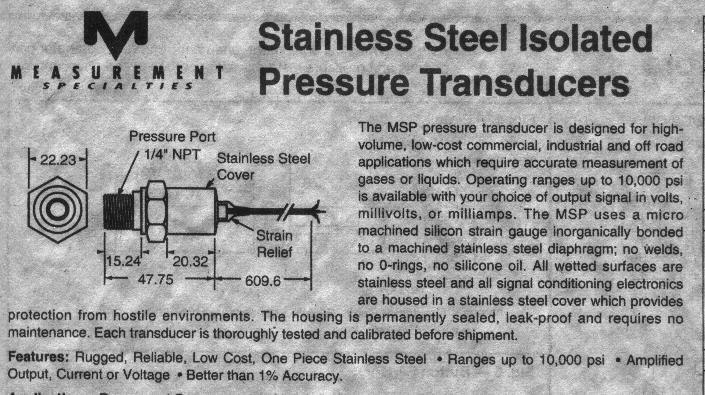
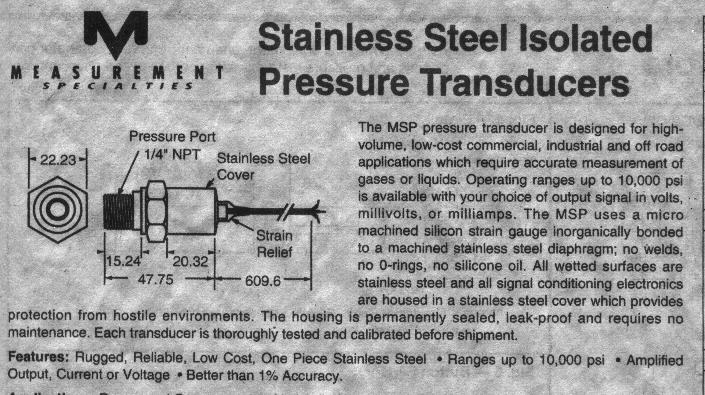
I was thinking this morning of getting a pressure transducer
and installing a scope camera on my oscillscope and
recording the pressure pulses from my 1985 12A RX7.
DigiKey has a 0-100 psi pressure transducer for $82.50.
A scope camera can be made with a light shield and
any camera that you can lock the shutter open. You
open the shutter while you spin the engine with
the starter.

This is the last word in definitive rotary engine condition
checks. Each chamber can be compared with all the
other chambers.  Real trick! Should be interesting.

http://www.digikey.com

Speaking of all this does anybody know of a low cost
bore scope that will fit in the exhaust port?

Paul Lamar

Hillweb wrote:
Paul,
DigiKey has a 0-100 psi pressure transducer for $82.50.
You could call Motorola an ask for sample - it is free!
Also they could send whole Eval. kit  for around $20 for
different sensors...  :-)

Vlad
Great tip. Is it self contained with /14 inch NPT
like the DigiKey?

If not it will still work with a short piece of hose
and a couple of hose clamps.

pressens.jpg

Paul Lamar

The Aircraft Rotary Engine Newsletter.              Powered by Linux.

http://home.earthlink.net/~rotaryeng/            http://www.linux.org