Ken Powell wrote:
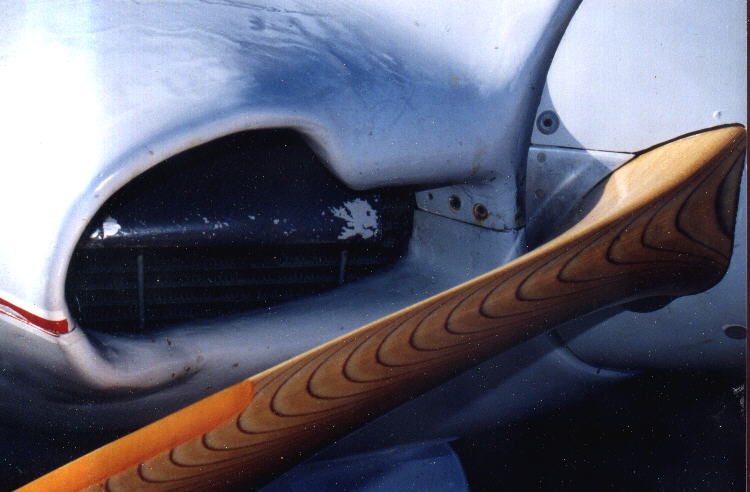
     I have been thinking about your proposed radiator system (single large
     radiator in the bottom of the cowl) and wondered about the positioning
     of the intake.  I notice that in most cooling systems (both air and
     liquid cooled - the Lancair that you mentioned is a good example) the
     air intake is located close to the spinner.  Is it a significant
     observation?
Good question. I would guess further out you would get more air.
     Note that the prop speed is much lower at this point and
     probably doesn't created the push / pull of airflow that a low mounted
     intake would be subjected to?  I also remember that Tracy Crook
     mentioned that his temps climbed when he installed a Warp drive prop;
     he thinks that the lack of an airfoil in the first few inches of the
     prop disrupted the airflow into his radiators.
The inner part of an IVO prop goes into a negative angle of attack at
some forward speed around 150 to 180 MPH. It is like running into a
brick wall. It will suck the air out of your intakes to the radiators.
     I think that it might
     be worthwhile to conduct some experiments with a duct that runs from
     just under the spinner to the bottom of the cowl / radiator.  Would a
     manifold pressure gauge mounted close to the duct entrance give us
     meaningful data on what is really happening in our intake tracts?
Or just a simple manometer. See the ACRE NL web site for an example.
BTW it is best to reference the pito air pressure that feeds pressure
to the air speed indicator. That is called dynamic pressure. It is not
enough to measure just the pressure drop across the radiator. That is
good
but it is better to know how well your diffuser is doing relative to
dynamic pressure. If your radiator is too thick and obstructs air flow
too
much the higher pressure in the diffuser can  affect the air flow into
the duct and force the air to go around the outside of the duct.

Where you need the most cooling is when the dynamic pressure is
the lowest.... climbing out a low airspeeds.

Opening the hole up helps but the drag is also much higher
at higher speeds.

It takes a higher pressure difference to force air through
a thick radiator rather than a thin one not to mention the
last half of the radiator does 1/4 of the cooling..
BTW, what size radiators did Jim Mosier use?
As a guess I would say they are about 13 to  18 inches
square and one or two inches thick. What are the real numbers
again Jim?

Paul Lamar

The Aircraft Rotary Engine Newsletter.              Powered by Linux.

http://home.earthlink.net/~rotaryeng/            http://www.linux.org