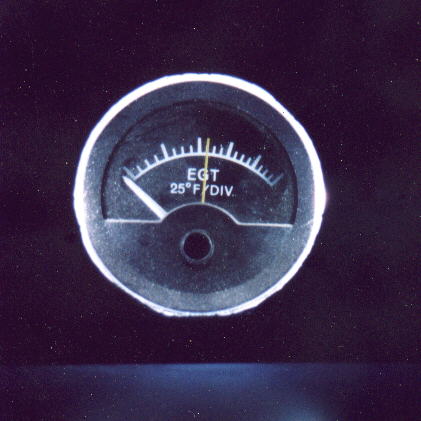
This has little to do with rotaries but I thought
I would share it anyway. I am going to need a bunch
of analog gauges to monitor the turbo so I am thinking
and planning ahead on the instrument panel.

This is my test panel. I used 1/4 inch Lexan as it is tougher
and easier to machine than plexi. I covered front and back
with shiny mylar tape and the front with something like
duct tape. I call it blue jean tape as it has that
color and texture.

I used highly efficient, high brightness LED's as they are a recent
development. This gives a uniform light all around the edge of
the instrument. I ground down the length of the  LED's slightly
so they would press completely into the 1/4 inch Lexan.
I also taped over the back of the LED's as a lot of light
escapes if you don't.

A real panel would  use up to two dozen high brighteness LED's.
Only two are used here but there should be an LED between
each instrument. Three on the bottom row and three on the top
row around each instrument.

LED's have been known to work for years. These high brightness LED's
are expensive for LED's at about $4 each in qty. of ten.

This panel is not really fiber optic. It uses the Lexan
to distribute the light, much as two mirrors would front to front
or back to back.

The LED's are about 5 mm in dia and you can get high brightness
blue and white. I used the white. Each LED consumes 120 milli watt
or 0.12 watt. The current drain is 20 ma or 0.02 amp each.
It would take fifty of these to consume one amp.

You can buy them at http://www.digikey.com
or 1 800 344 4539

A $2 variable regulator from Radio Shack or DigiKey and 75 ohm dropping
resistors on each LED allow you to vary the brightness with a very
low power pot. the voltage across the resistor and the LED
should vary from about two volts to ten volts.

On the other hand a 14 Volt  T 1-3/4 incandescent miniature lamp would
consume .08 amps. Four times as much and run hot.

Paul Lamar

The Aircraft Rotary Engine Newsletter.              Powered by Linux.

http://home.earthlink.net/~rotaryeng/            http://www.linux.org