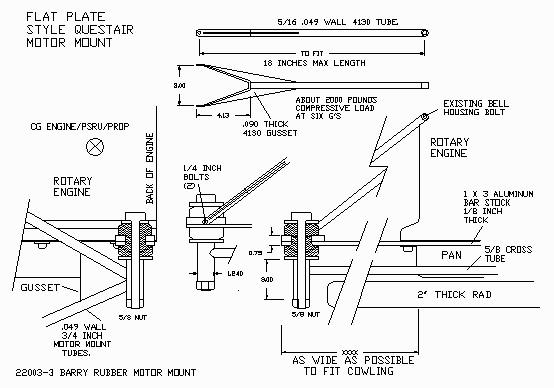
I was not always entirely happy with the three inch square aluminum
tube motor mount. Then I started thinking about how I could
optimise the space under the engine to allow installing a large area
thinner radiator for good cooling. I then realized that if I went to
a truss design the lower member of the truss would always be in
tension. So I decide to go with a one 1/8 inch by three inches wide
flate aluminum bar stock. This would allow using the pan bolts to
bolt it to the bottom of the engine near the rear end housing
area. (The front of the engine in a tractor installation.)
It would also allow raising the motor mounts relative to the
engine as well.

The pan would be truncated short of the plate as it is
not needed in that area. The oil pickup is on the other
end.

The design worst case is a six G emergency  pull up or
dropping the airplane in on the gear. The engine weight
is assumed to be 300 pounds so that results in a
900 pound download on each motor mount. The load
on the rear mount is minor by comparison.

The compressive load in the top member of the truss
is about 2000 pounds which will not buckle a 5/16 diameter
0.049 wall  4130 tube eighteen inches long. The tubes
are attached at the top to existing bell housing bolts.

The tension load in the 1/8 thick aluminum
bar is about 1600 pounds so the peak one time stress level
during a six G pull up is 4300 psi. Not much for 6061 T6
aluminum plate. A few pan bolt holes in the bar will
not hurt.

Out where the rubber motor mounts go the
bar is thickened up with a welded on 3 by 3 by 5/8
thick aluminum plate. Holes are drilled and tapped
in these plates for two 1/4 inch aircraft bolts to
take the 2000 pound compressive loads in the 5/16
inch tubes in single shear. This is well within the
capabilities of a 1/4 inch aircraft bolt.

All this assumes the motor mounts are
thirty six inches apart which is a lot for most cowlings.

What all this allows however is a somewhat wider radiator
that will still fit in most stock cowlings. The
angle of the radiator can be greater and therefore it
can be tucked up under the engine at the front to
better utilize the width at the front of the cowling.

If the flat plate scares you a little you could use
a one inch by three inch  by 1/8 inch thick aluminum
angle instead.

One of the side benefits here is it is probably
lighter in weight than any cantalevered cross beam
type mount such as the two inch 4130 tube or the
three inch square aluminum tubing.

Paul Lamar

The Aircraft Rotary Engine Newsletter.              Powered by Linux.

http://home.earthlink.net/~rotaryeng/            http://www.linux.org