I was speculating about the reasons that angled radiators are working
so well in several installations. Jim Mosur's RV6 is a prime example.
The obvious is the radiators are thin and passing more air.

Obviously for any give dynamic pressure there is an optimum thickness
for the radiator. Too thick too little air. Too thin not enough
heat transfer to the air passing through. The optimum thickness
probably changes with forward speed and altitude of the airplane.

Since taxi,takeoff and climb are the big problems it appears
that about two inches thick is near optimum.

If you have a real high HP airplane like a P51 with a fast slip
stream from the prop the optimum would perhaps be thicker.

There may be another subtle factor here and that is the first
half of the core  is doing 3/4 of the cooling so any early
turbulence in the air entering the core may enhance the
heat transfer. The air turning that sharp corner into the
core probably goes bananas.

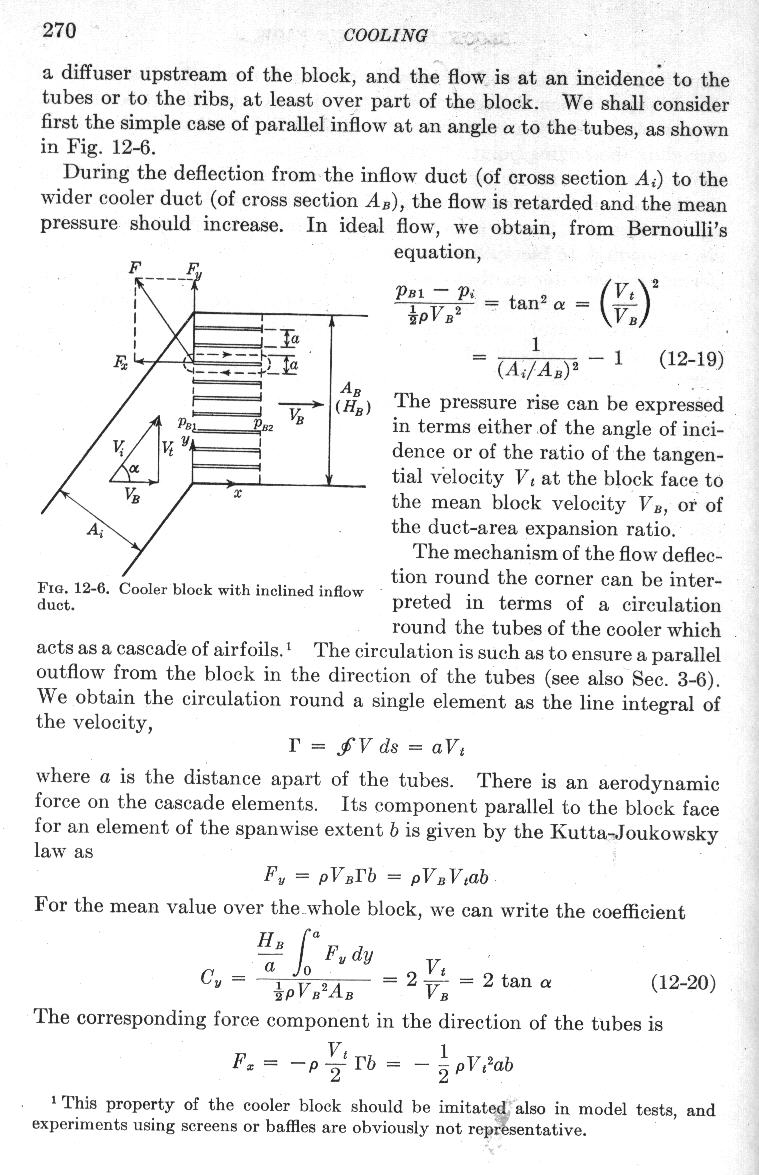
Kuchemann & Weber in their McGraw Hill book; The Aerodynamics
of Propulsion surmised that there existed recirculation
in the core due to the low pressure on the back side of
the fins. I find that hard to believe at high dynamic
pressures but I guess it is possible at certain air
speeds.

Hoerner in his classic book Fluid Dynamic Drag also
noted that certain ring radiators used in German WW II
fighter planes and bombers worked quite well when the core
was oblique to the airstream. He called it the drum type
of radiator.

obliqueb.jpg is a page from the Kuchemann & Weber

Sorry about the size but there are some small labels.

Paul Lamar

The Aircraft Rotary Engine Newsletter.              Powered by Linux.

http://home.earthlink.net/~rotaryeng/            http://www.linux.org