Rodger Hilyard wrote:
Paul wrote:
I have been giving a lot of thought lately to the cooling
problem. So far we have been going on pure experiment only.
I thought I would run this by you for comments.

Preliminary givens:

A: The cooling HP  needs of the engine is fixed at roughly 100% of
the output HP and not a function of airspeed. Particularly
with a constant speed prop. One HP is 2545 BTU's per hour
or 745 watts. Normally aspirated output HP of course decreases
with altitude.
 ( A )  Norby's repro of Mazda Engine Thermo Use suggests
  the following;
            @ 6000 RPM
                    To unburned gas-------------------------12%
                     To exhaust gas--------------------------38%
                      To oil ----------------------------------08%
                      To cooling water ---------------------  20%
                      To net horse power ------------------- 22%
  This applies to automotive fuel BTU content at the time.
   A/C 100 LL if properly burned contains 18,500 BTU's
per lb , or at 6.0 lbs per gallon, 111000 BTU's per gallon.

    Much of the data that I have seen indicates that the rotary
combustion chamber makes max power at a 12:1 Air / fuel ratio
which is pretty rich. Even if you were able to get 0.62 lbs per
HPx hr efficiency,  a 150 hp X .62 lbs.hr = 93 lbs per hour (15.5 GPH )
of fuel or 1.55 lbs per minute X 18500 BTU per lb =
28675 BTU's per minute fed to the engine.

   Taking the Mazda research  word, 20% or 5735 BTU's go
into the water radiator, 2294 BTU's go into the oil radiator
PER Minute. There is considerable inter action between the
oil and water heat flows and the test data didn't show how
this interaction played out. But you can expect that oil temps
much higher than water temps will push more BTU's to the water.

 To be continued........
Rodger
This is about right. 20% to the rad 22% to power out so power out
roughly equals waste HP of rad cooling.

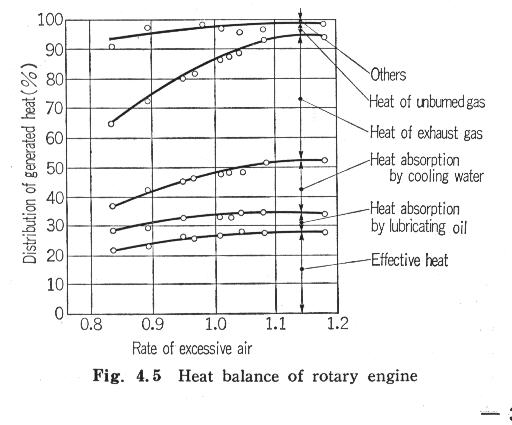
However I think the Norbye data is a little out of date as his book was
published in 1971. Here is a little more recent data directly from
Mazda.
The area labeled "effective heat" is power out of course.

 hetbal81.jpg

Paul Lamar

The Aircraft Rotary Engine Newsletter.              Powered by Linux.

http://home.earthlink.net/~rotaryeng/            http://www.linux.org