Rodger Hilyard wrote:
Paul wrote:
I have been giving a lot of thought lately to the cooling
problem. So far we have been going on pure experiment only.
I thought I would run this by you for comments.

Preliminary givens:
B: The mass flow of air available for cooling with
a fixed air inlet area is directly proportional to air speed
and air density. It is proportional to air speed times inlet
area times air density. The worst case is probably climb
air speed or about 80 to 100 MPH.
------------------------------------------------------------------------

  Well we got the heat out of the engine and into the radiator and
we know the heat content ( 5735 Btu's per minute ) the temperature
drop the radiator must provide ( 61 deg F ), and
the radiator outlet temp. ( 139 deg F ).
Now we must couple this into the AIR.

 To be continued............

So how much " AIR " do we need ?

 Just like Water / Ethylene Glycol mixture, Air is also a mixture.

 We can again use the Specific Heat to measure our temp rise
per unit mass, but as a gas is compressible there are two
possible values to use.

 One value is if we apply heat to a constant volume (contained )
The other is if we apply heat to a constant pressure ( unconfined, able to
expand ) i.e. through your radiator core and out the ducting.

There is also an effect due to the vaporized water in the air,
AKA humidity.

 For worst case probability I have chosen 100 deg F and
a low humidity of 20%, because water vapor is almost
twice the specific heat of air, per lb weight.

 Large cities in closed basins often exhibit temperature
" inversions "where the temp does not drop with altitude.
It is possible to have high temps at 3000 ft AGL and for
you to be trapped below some airspace " floor " for some
time. So said to discourage you from discounting the 100 deg
temp. because of the " you will quickly climb out of that " idea.

 From my 1954 Physics Text book ,which still gives things
in non metric units:

  100% humidity at 100 deg F equals 0.00285 lbs per cubic foot.
    20% of that equals 0.00057 lbs per cubic foot.
 Specific heat of Water Vapor equals 0.48 Btu's per lb per 1 deg F.
   0.00057lb per cubic foot times 0.48 Btu per lb per 1 deg F
equals 0.0002736 Btu per cubic foot per 1 deg F .

  Air has a weight of 0.081lb per cubic foot.

 The specific heat  at constant pressure, between 32 -212 deg F
is given as 0.242 Btu per lb per 1 deg F.

   0.081 lb per cubic foot times 0.242 Btu per lb,  per 1 deg F
equals, 0.0196 Btu per cubic foot per 1 deg F.

 Adding the humidity and the air capability one gets,
 0.0196 Btu + 0.0002736 Btu Equals 0.01988 Btu per cubic foot.
per 1 deg F temp rise.

 If we allow a 50 deg F temp rise of radiator exhaust temp we
will extract 0.01988 X 50 Btu per cubic foot of air flow.
 Or .994 Btu per cubic foot of air flow.

5735 Btu heat load divided by 0.994 Btu per cubic foot
air flow requires ( 5735/.994 = 5770  cubic foot per minute
air flow ).

  At 80 MPH or 7040 ft per minute, we would need
5770 cubic foot / 7040 foot per minute =  0.82 square foot
 ( 118 square inch ) intake area.
Sounds a bit big. Most recent airplanes are using two roughly
four inch diameter holes. That works out to about 24 square
inches. If they are five inches that would give about
40 square inches. Course they climb closer to 100 MPH.
 The exit area to pass the heat expanded gas , just matching
A/C speed and NOT accounting for pressure loss of radiator or
ducting is :

     ( Pressure X Volume / Absolute Temp ) Input Air
                      Equals
     ( Pressure X Volume / Absolute Temp ) Exit Air

 Or the volume increases as the ratio of the Absolute Temps.

    100 deg F = 560 deg Rankin
    150 deg F = 610 deg Rankin

     610 / 560 = 1.089

   1.089 X 5770 CFM =6284 CFM Exit air volume.
    6284 CFM divided by 7040 feet per minute
   Equals 0.893 square foot Exit Area.

   Some of the conditions used here may not be what you
would use i.e. you may well choose 100 MPH as your
expected worst case speed, reducing your air inlet / exit size,
however the volume of air you must flow will be the same,
for a 150 HP , running slightly air rich i.e. 15 lbs Air: 1 lb fuel.

  So now we know :

     Heat to get rid of...............................................5735
Btu's

      Radiator inlet  temps..........................................200 deg F

       Radiator outlet temp...........................................139 deg
F

       Minimum air flow @ 50 deg F exit air rise......5770 CFM

       Minimum Inlet duct size at 80 MPH....................118 sq. in.

       Cooling Flow...................................................... 13
GPM

      Inlet Air temp.......................................................100
deg F

  Next we will look at the radiator parameters that will
meet these conditions. Probably more fun than a fellow
can stand....

To be continued........................................................
You are doing a great job Rodger. Please keep up the good work.

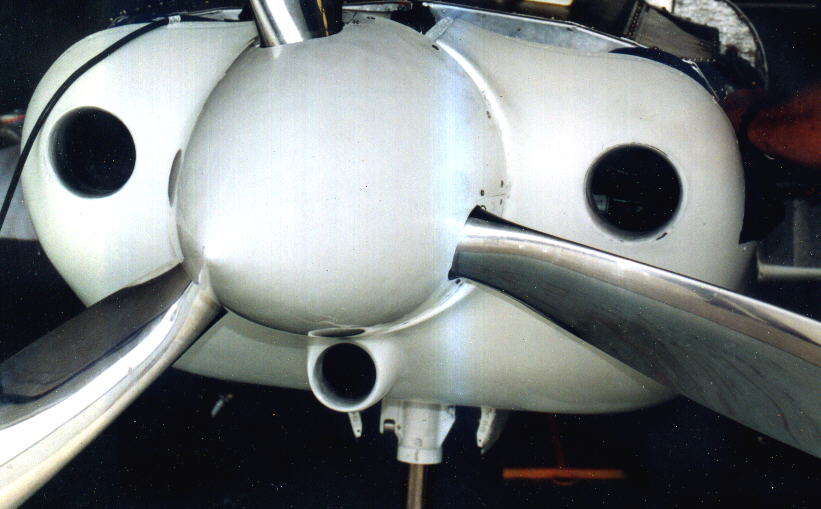
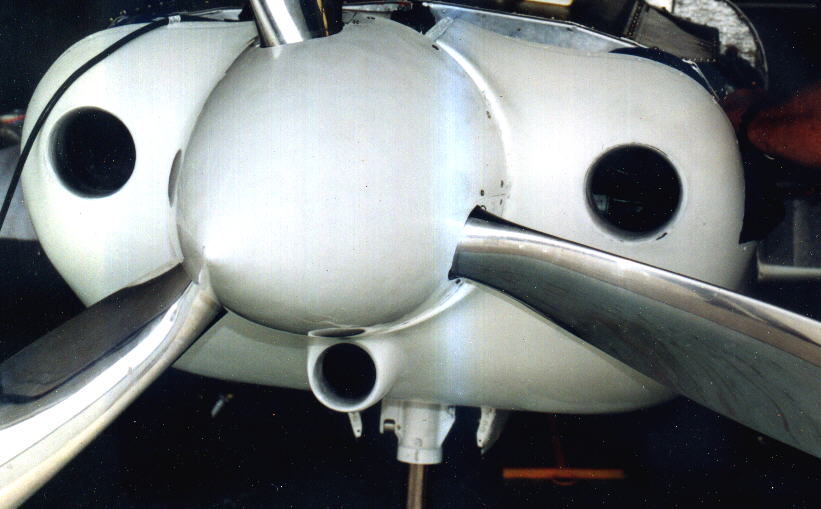
Here is a picture of Dan Wright's SX300 cowl. Dan finished
sixth at Reno last week. I suspect he has around 400 HP.

 dancowl.jpg

Paul Lamar

The Aircraft Rotary Engine Newsletter.              Powered by Linux.

http://home.earthlink.net/~rotaryeng/            http://www.linux.org