Ken Powell wrote:
     I would like to make an observation based on the data furnished to us
     by Ed, Jim and Tracy.  These 3 installations are all cooling well at
     this time (Tracy told me that he did not need the spray bar cooling
     over the radiators during the 40 minute taxi at Oshkosh in 100 degree
     heat) and may or may not have radical differences in cooling drag.
     What we do know is that Tracy is putting out the most HP and Ed the
     least, with Jim somewhere in between.  Maybe we need to be copying
     Tracy more (the greatest form of flattery is???) on the production of
     HP.
     It seems that we have previously decided on an intake length of
     24 inches and an exhaust of 31 inches as a good starting point.  This
     may or may not be the right lengths in the real world; Tracy is using
     a tuned intake that appears to be much shorter and an exhaust that is
     certainly much shorter but seems to be low in back pressure.  We also
     know that a tuned length intake needs 'air horns' for optimal results
     but Tracy's design does not seem to have this requirement. The next
     guy to get running needs to test both of these systems during ground
     running to determine what works best.  Yes, I realise that packaging
     will limit many of us, but those of us building side by side planes
     should be able to build either.  I have not tried to cover all the
     variables here, just wanted to point out that we do have the benefit
     of the research these guys have done for us.

     Ken Powell
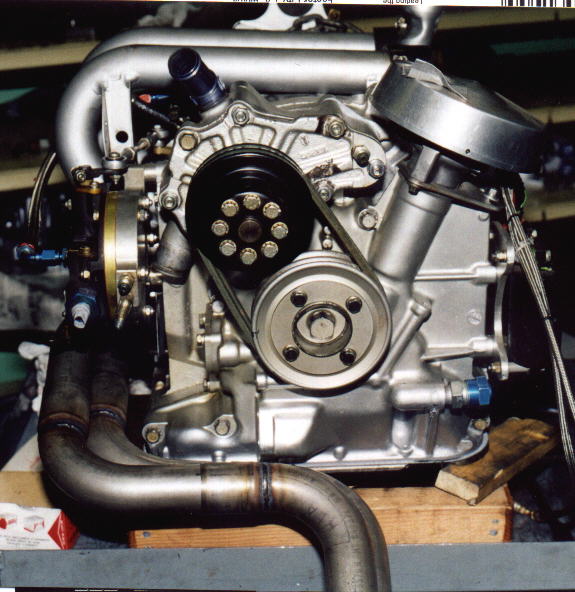
The picture is of Everett Hatch's engine currently generating 210 HP
at 5850 RPM on the Power Sport dyno.

The intakes are about 24 inches long and the exhaust pipes
are about 31 inches long. The main difference is
peripheral ports. This engine has pulled Allan Tolle's RV3, if memory
serves me correctly, at 238 MPH for 100 miles in the Sun 100 race
at Sun & Fun in Florida a couple of years ago. The fuel injection
is now electronic but everything else is the same with the
exception of the currently installed  radiused air horns on
the intake tubes. The PSRU ratio was about 2.3:1.

All you need do is build one. You can also buy one like it
from Power Sport complete with cockpit computer/LCD EFIS
and PSRU for about $18,000.

Paul Lamar

The Aircraft Rotary Engine Newsletter.              Powered by Linux.

http://home.earthlink.net/~rotaryeng/            http://www.linux.org