Paul Yaw wrote:
Paul Yaw wrote:
I would imagine that "recycling" the portion of the charge that didn't
burn the first time around will really pay off, but I don't think that
it will ever compete with modern piston engines.  The Honda VTEC engine
has a BSFC of about .43 tuned for best power.  The Mazda V6 that we
messed with was pretty close to that, but I don't remember the exact
number.  Maybe .45 or .46.  Very impressive!

PY
By agressive leaning at altitude Tracy is seeing 0.47 or 0.48 with the
rotary which is not that far away from a Mazda V6 piston engine.
How does he know what BSFC he is getting?  That sounds possible, but how
does he know?
I will let Tracy answer this but I suspect he has a pretty good idea
of what the drag is. He mentioned this a while back but it would be hard
to find unless you have Netscape Communicator (which I don't) and can
search for key words in the body of the ACRE NL  messages. PL
I am referring to best power tune, but I guess that is not all that
important in an aircraft.  Should I be thinking in terms of lean
cruise?
Yes Paul you should. With a high power to weight ratio airplane
that climbs at 1500 to 2000 FPM and with a variable pitch prop one does
not spend much time climbing in the East and Midwest. Out here in the
West
or racing is another matter. One could spend a half hour climbing out
of a five hour flight. You are soon up in rarified air of course. PL
All the numbers I have mentioned refer to best power setting.
Next time I build an AC engine I would like to experiment with this, and
see if the ignition timing should be changed for this lean cruise
condition.  Since changing the mixture changes the burn rate this might
be worth looking into.
It is very interesting to see those numbers Paul. Almost everybody
advocating water cooled car piston engines assumes BSFC is well below
0.40.
I can't claim to be a piston engine expert but I believe that to be pure
fantasy.  Can anyone out there comment on this? (Dyno numbers please.)
Most engines that I have fiddled with are Chevy small blocks, and a
really good one will dip into the fours at its torque peak.  The 2.3
litre Fords are a little worse, and the Japanese fours are noticeably
better.  The Mazda V6 was a work of art.  Ross Farnham at SDS claims
high fours for the Toyotas he worked with.  Again, that is best power
tune.  He also mentioned some extremely low numbers that he heard but
couldn't believe.

 Actually water cooling is a drawback as running an engine
at 212 F means  more heat energy is given up to the coolant while
an aircooled aircraft engine will run 300 degrees or above.

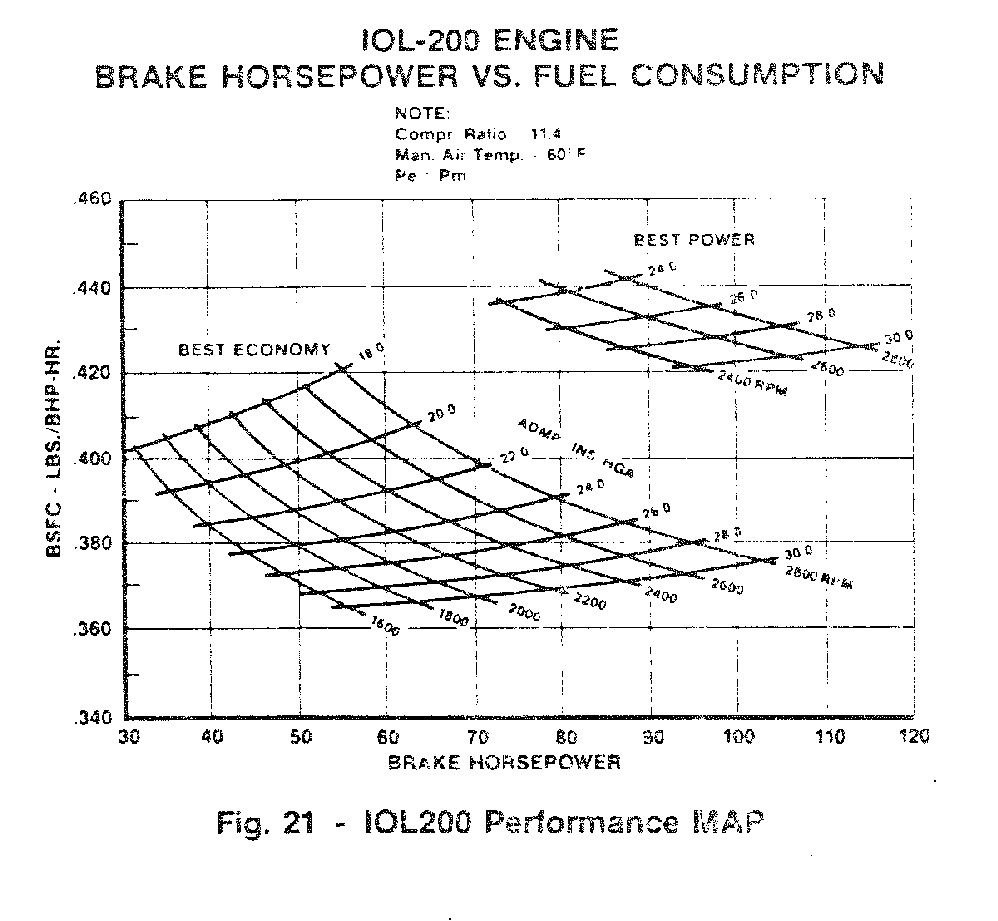
The Continental SAE paper mentioned on the ACRE NL web site
http://home.earthlink.net/~rotaryeng/ on liquid cooled aircraft
engines discusses this factor at length. Continental was
able to get the liquid cooled Voyager aircraft engine
series below 0.40.
Was that tuned for best power? Nevermind, I will read the article.
Hold on I will check. Here is a complete map voyengf1.gif
This engine pushed the Rutan Voyager around the world un-refueled. PL
BTW the number I have for the big block Chevy is 0.53.
That seems about right, but I would think it could be better if designed
specifically for the application.  By the way, I don't build piston
engines, I just mess around with them when my buddy Norm has them on the
dyno.  Lessons learned there can almost always be applied to a rotary.

PY
The Aircraft Rotary Engine Newsletter.              Powered by Linux.

http://home.earthlink.net/~rotaryeng/            http://www.linux.org