Fred wrote:
snips...
Drag is the momentum drag (cooling drag) that results from the cooling air
flow alone assuming that the outlet area is adjusted via cowl flap to the
optimal value to accelerate the existing hot air as much as possible using
any surplus pressure left over after paying the losses in the inlet diffuser
and across the radiator. No drag effects from external belly scoops, etc. are
included since they require separate analysis.
snips...

This is why I try to keep the rad under the cowl. No external belly
scoops..
no additional drag.
Interpretation of results:

More radiator frontal area equals less drag.  No surprise.  The problem is
packaging a big thin radiator in a little airplane.  Two radiators in a
shallow V might be possible to conform to the round cowl shape.  I favor the
chin scoop previously illustrated (Beckman air plane? - I don't recall) with
radiators below the engine blowing their exhaust upward to cool the hardware
in the cowl before exiting out the bottom by the firewall or out the side.
Use cowl flaps.
snips..

I whole heartily agree with this. With the KIS cruiser I have room for a
24 inch by about 18 or 19 inch wide rad mounted at an angle under the
engine. Fred shows the drag for the two inch thick 24 by 16 inch rad
as about 4.3 pounds at 220Kts. I intend using two one inch thick
Ford Mustang radiator's back to back with hot coolant first flowing
through the rear rad and then through the front rad. I will check
the fin and tube spacing and compare those numbers with the
numbers Fred mentioned.

>From Fred's second chart:
Since I think in MPH... 220Kts is about 253 mph or about 370 FPS. HP
is drag X FPS divided by 550. That means the HP consumed for the cooling
system is a minimum of about 3 HP at 220 Kts not counting other little
things like lost pressure because the air has to turn 90 degrees and
go through the rad and find its way around the engine and out the exit.
Hopefully it is going real slow while doing all this so this effect
should be minimal. Even if you double the drag it is still very
low. It is very important however to streamline the exit area of
the cowl where the hot air is speeded up.

All this sounds very very good. Only three to six  HP lost to cooling
drag is outstanding! I don't need the additional drag from a belly scoop
of any kind. We are so lucky to have such a small engine that we
can get the rad inside the cowl. Liquid cooled piston engines
are not so good.

Thanks again Fred. Excellent job.

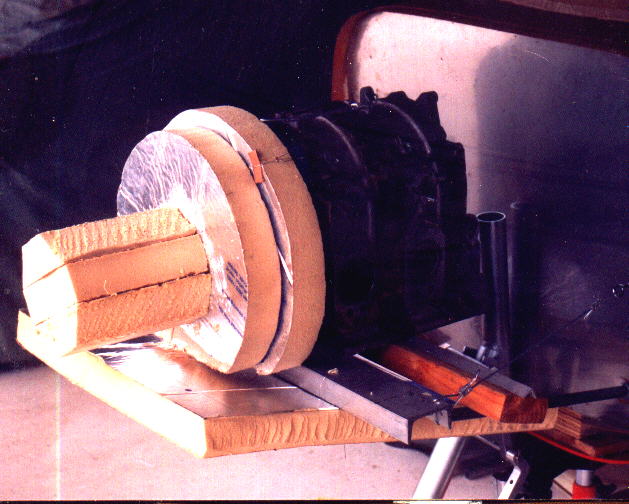
The picture shows a crude foam mockup for the KIS cruiser.
The stock short KIS cowl fits over this fine. There is plenty
of room on one side of the engine for turbo, side exhaust
and cowl flap. On the other side of the engine will be a intercooler
and manifold combination plus the alternator. I am thinking of
using two oil rads. One on either side of the landing gear
horizontally mounted under the engine  back by the firewall.
Sort of extensions to the cooling rad. Another place that would
work for one oil cooling rad is up under the PSRU mounted
horizontally more or less. Being narrower than the cooling
rad it will fit in the cowl in that region. A down side to
this location is it would blow hot air on the PSRU and
the starter.

Paul Lamar

The Aircraft Rotary Engine Newsletter.              Powered by Linux.

http://home.earthlink.net/~rotaryeng/            http://www.linux.org