Fred wrote:
Al:

Thanks for your questions.  They are good ones.

1) Drag shown in the graphs is for the flow through the radiator only, and is
proportional to the net loss of momentum from this stream of air in going
from the free stream velocity to the outlet exit velocity.  I assume the
outlet is pointed directly backward.  Pointing it down is a waste of time and
speed.

2) How much drag due to inlet diffuser losses?  I haven't broken it out in
relative amounts, although I could go back and calculate the distribution of
losses.  I assumed for all cases that the overall diffuser performance is
75%, that is, 75% of the total ram pressure is obtained at the face of the
radiator.  For a REALLY good diffuser, you might get 90%, and if you do an
awful job, maybe 50%.
Lots of snips....

In light of what Fred has so kindly explained so far we need some
pressure measurements on diffusers.

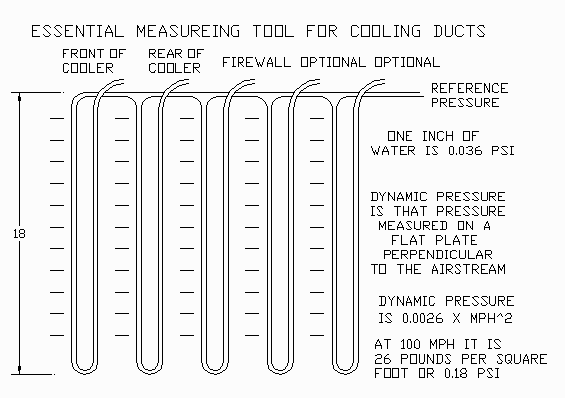
I have mentioned this several times before but it is worth repeating
because we have many new subscribers. I highly recommend this simple
device to measure the pressure recovery of your diffuser relative
to the airspeed. Connect the reference tap to the same line
that feeds your airpseed indicator.

This device is extreamly low cost and a simple
box camera can be used as a recorder. Place the pressure taps
at several position around the front of your radiator.

It is made from clear plastic tubing about 1/8 inch in diameter
and filled half way with distilled water.

Ignore the suggested tap location settings in the sketch and focus
on the pressure distribution on the face of the radiator
core.

If more people would do this we could build up a history
of how well different types of diffusers worked for our
applications.

Paul Lamar

The Aircraft Rotary Engine Newsletter.              Powered by Linux.

http://home.earthlink.net/~rotaryeng/            http://www.linux.org