Fred.com wrote:
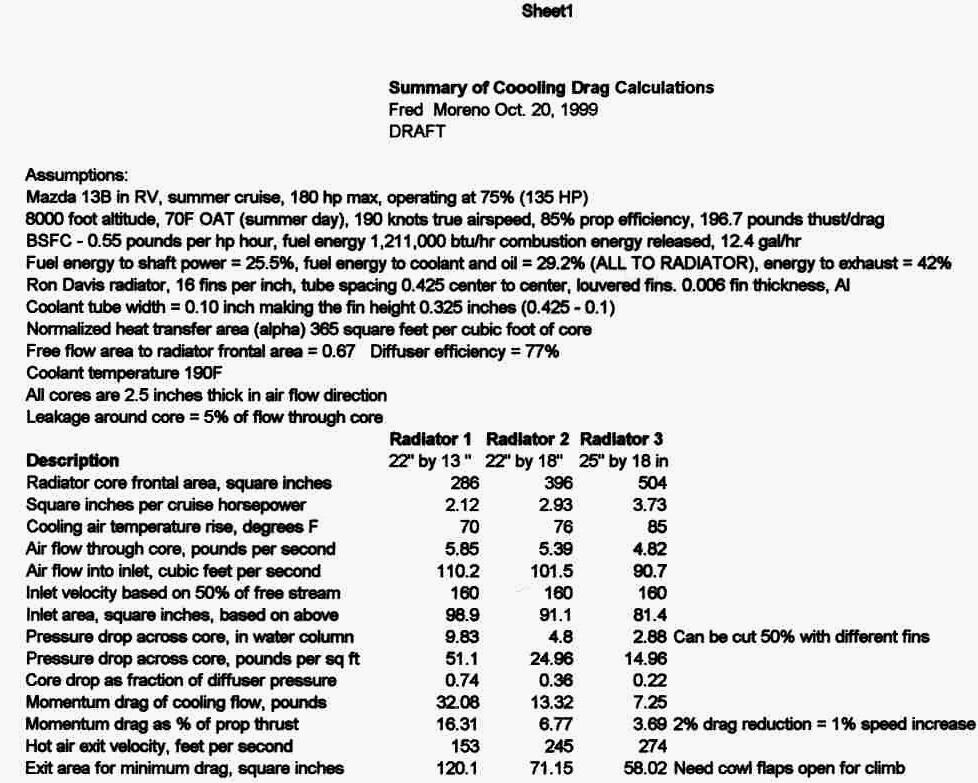
Mike Wills asked me a series of questions that motivated me to conduct some
preliminary analysis in search of answers.  Mike is building an RV-3 (if I
recall correctly) and is planning on using a 13B engine with 180 horsepower.
He is located in Southern California, so I did some cruise analysis for a hot
summer day, typical of this region (70F at 8000 feet) assuming 75% power
(aspirated) and a BSFC of 0.55 pounds per hp hour.

The resulting energy rejected from the heat exchanger seems high, so I would
like the collective wisdom concerning the energy balance and fuel consumption
for the engine: BSFC (is .55 right?) and per cent to exhaust, shaft power,
and to coolant plus oil.

I summarized three sets of computer runs on the table attached.  Only the
frontal area of the radiators was changed.  Inlet and outlet areas were
computed for each case based on the flow required and the available energy
downstream of the radiator.  Note that I assumed all coolant and oil heat
went to the radiator.  If a separate oil cooler is used, its area may be
deducted from the radiator area if they are roughly the same in fin
configuration and thickness.

Enlarging the radiator reduced the drag considerably, an amount that is
roughly equivalent to about 11-12 knots for the speed assumed (190 Knots TAS
which seemed appropriate for the approximate frontal area of the RV and
horsepower available).  Mike suggested 180 mph but this resulted in a flat
plate drag area that was way to big, so I increased the speed until the area
was about 2.2 square feet which seemed about right  Comments and corrections
welcome.

I marked the table a draft because I am uncertain about the speed and energy
figures.  I welcome (indeed, invite) review, corrections, and comment.

Based on Mike's preference, I have assumed the use of a Ron Davis NASCAR
style radiator with the louvered fins which are higher drag than the best
available, but such units are available off the shelf at an attractive price,
or so I understand.  The "best" fin design I am aware of would reduce the
drag figures and pressure drop figures presented by about 50%.  This would be
worthwhile only for the smaller frontal area radiators.  The tradeoff is
clear: go for maximum radiator frontal area feasible.  Spend money on high
performance custom-fin radiators only if you cannot wedge a larger radiator
into your package.

Once we get the figures right, we can start looking at diffusers and flow
distribution over the radiator since these large areas make steeply inclined
radiators a foregone conclusion, and getting even flow distribution is going
to require some experimentation.  (Are you listening, Paul??)

Fred Moreno
Couple of notes. I think .55 is a little high for cruise. That would
be a good number for max power climb. Leaned out for cruise it is
more like .5

Heat loss to coolant leaned out is about 17%. Running rich for max
power heat lost to coolant is about 12%.
Heat lost to oil is almost independant of mixture at about 7% to 9%
rich to lean.

BTW Fred sent a large image. Too large to handle so I divided it up into
two.
Here is the upper part first.

More good woork Fred. You have added tremendously to our knowledge on
this subject.

Paul Lamar

The Aircraft Rotary Engine Newsletter.              Powered by Linux.

http://home.earthlink.net/~rotaryeng/            http://www.linux.org