BTW I forgot to mention that the resultant power to
weight ratio based on a 13B dry weight of 230 pounds
with PSRU and 240 HP of 1.05 HP per pound would wip
the heck out of any piston aircraft engine available
today.

If it were not for the liquid cooling system that
would be true.

If you add another 40 pounds for the liquid cooling
system
you obtain a total weight of about 280 pounds and
you
get a power to weight ratio of 0.85 which still wips
any
available piston aircraft engine by a bunch.

Take a look at the 407 pound weight of the popular
250 HP
Lycoming IO-540 in the chart I just uploaded.

Paul Lamar
Vance Jaqua wrote:
I think you are being just a little unfair since 240
hp
is a "hot rodded" number and I am sure that "Pushy
Galore" was exceeding that number in the time to climb
mode as are the big radials at Reno - Vance
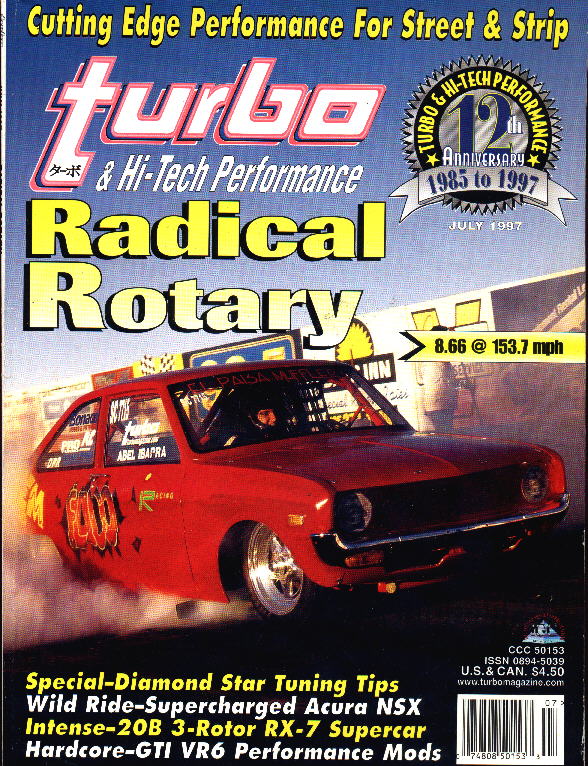
It is not really a "hot rodded" number.
A hot "rodded number" for a 13B two rotor is 730 HP.

I'll bet you a $100 Vance that a 13B  rotary will live 100 times
longer at 240 HP than an O-200 will live at 240 HP.

The time to climb for Pushy Galore was one minute or less.

Allen Tolle's 13B RV beat that time but did not make it to
the runoffs because of a plain bearing design error.
The bearing did not fail in the time to climb race
it failed in the 100 mile Sun 100 cross country race.
The bearing was too narror for its diameter hence
it lost the dynamic oil film.

A stock RX7 Turbo street engines are currently 280 HP.

The latest normally aspirated side exhaust port engines are
also 280 HP at 9000 RPM.

240 HP at 6000 RPM is a piece of cake.

The magazine cover is of Abel Ibarra of Riverside CA and his 730 HP
2000 pound stock steel bodied R100 race car. Since then he has gone
over 165 MPH in under 8 seconds with this car. Note the cover date
of July 1997.

Now THAT!!!!! is a "hot rodded" rotary engine.

Paul Lamar

The Aircraft Rotary Engine Newsletter.              Powered by Linux.

http://home.earthlink.net/~rotaryeng/            http://www.linux.org