Brian D. Cain wrote:
Hey guys, the subject of the heat differences between
the front and rear rotor chambers has been something
that's floated in and out of my mind from time to time.

In our automotive crowd, it seems that the common failure
of the turbo engines is the classic partially-shattered apex
seal in the rear rotor chamber.  That's nice and all but it
seems as if that encompasses a very large percentage of
the engines that are blown from high-output use, say
"spirited" driving and/or racing.

One of the potential causes of this I believe is the heat being
transferred to the rear iron end plate from exhaust gas
entering the 'EGR jacket'.  I know there's some subtle
differences between the two that may contribute, like having
a huge fan blowing right on the front cover and a few other
things, but this one concerns me a bit.  Most people
have removed the EGR valve and have substituted the valve
with a block-off plate in its place.  The problem remains, however,
that there is still an exhaust port in the rotor housing's exhaust
sleeve, if memory serves, where those gasses will travel
through a dedicated EGR jacket into the lower intake manifold.

My gut says this might be one problematic area.

Any opinions on this, guys?

B
Tracy Crook wrote:
I think that the fact that the rear housing gets water that was pre-heated
by the front rotor is a much bigger factor here.  But your point about the
EGR path is valid.  Just to make sure, I had Bruce plug the EGR path at the
exhaust port when he built my engine.

Tracy Crook
www.rotaryaviation.com
rws@altavista.net
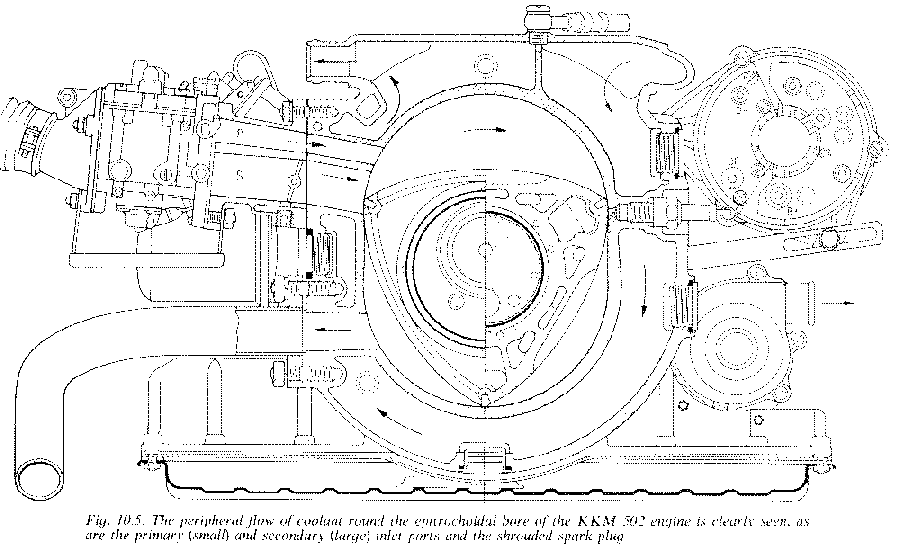
It was Max Bentele of CW that came up with the axial water flow scheme
I think. Mazda of course perfected axial flow. One mistake Mazda made
was not having the inlet and outlet in the center housing like the CW
versions. That would even the temp on front and rear housings.

IMHO NSU's orginal scheme of parallel flow into the rotor
housings would have been better for high power rotaries. I think NSU
should have stuck with it and perfected parallel flow. They gave up too
soon and went to the CW/Mazda scheme. See the attached drawing below.

All real heavy duty engines including early liquid cooled aircraft
engines
had parallel flow. The Chevy based Orenda V8 engine has been converted
to
parallel flow. Everett Hatch was experimenting with it but never really
got it to work well. IMHO with enough time and money the Mazda rotary
could
be successfully converted to parallel flow. Stock housing could be
machined
down and 1/4 alloy plates welded to each side to seal off the water
passages.
The existing webs with bolt holes could be machined out of the housings
leaving just enough material to tie the inner and outer walls of
the water jacket together. This would also eliminate the
troublesome coolant O rings.

These extended plates could then be used as flanges to bolt the engine
together with new alloy end housings. That would also solve the long
steel
tension bolt problem by doing away with them. External manifolds could
then be
used to supply and remove the coolant in a parallel fashion. If I were
much
younger and much much richer I might take a long term project like that
on. :-)

Paul Lamar

The Aircraft Rotary Engine Newsletter.              Powered by Linux.

http://home.earthlink.net/~rotaryeng/            http://www.linux.org