Jeff Spitzer wrote:
At 03:06 PM 10/29/99 -0700, you wrote:
This aluminum plate floats all over the back side of this
radiator with a K&M diffuser. The plate is six by eight inches
and is .040 thick. Your home work assignment  is to calculate the
air speed exiting the radiator. I want to see all intermediate
calculations. The home work assignment is due by Tues morning.
Mass=6*8*.04*.1=.192 lb == Drag

.192=.5*.002377*v^2*(48/144)*Cd

For Cd of 1.0 V=22 ft/s at S.L.

Show more of your test setup and elaborate on the results if you would.
I'm quite interested.

Jeff Spitzer
Jeff wins.

Keep reading. Look at the picture with the person in
it that looks like a dog.

I would guess the pressure on the
front side of the rad is about a 1/2 inch of water roughly.
I just completed the rig today so will be taking more measurements
in the near future. The rad is one inch thick and it is from
a 1991 Ford Taurus. The core, as I recall, is twenty inches long
and fifteen inches wide. The inlet is nine inches square
from the home AC squirrel cage blower.

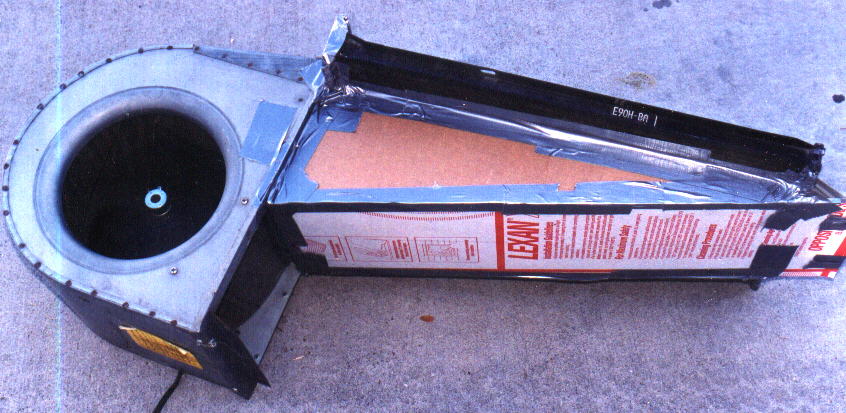
This is a picture of the orginal, too crude, wedge shaped duct.
90% of the air came out of the sharp half of the rad duct.

Paul Lamar            wedgduc3.jpg

The Aircraft Rotary Engine Newsletter.              Powered by Linux.

http://home.earthlink.net/~rotaryeng/            http://www.linux.org