Mike Wills wrote:
 Thanks for all the comments on this guys. There are a couple of things I'd
like to clarify since Paul and I have had quite a lot of off-line email
about this that you guys havent seen.

 First Paul mentioned that the major advantage to this design was that no
welding is required. I do consider this an advantage though not the only
one. Since there is no welding involved there is no requirement for any
elaborate jigging and no stable fixture is required to prevent the mount
from moving/warping while welding. Another advantage for this configuration
is that it puts no structural tubing under the engine which is where my
radiator and oil cooler will reside. Not a lot of space under the RV4 cowl
for this stuff, particularly if you remove the cowl "cheeks". Finally since
there is no modification to the existing Van's supplied conical mount,
switching to Lyc power is a bolt on at a later date. I think this may be
desirable in the future for resale purposes. IMHO no matter how good we
think the 13B is as an aircraft engine the rest of the aviation public isnt
buying it. I would imagine that a 13B powered RV4 is probably unsellable.
How do you finance the next project if you cant sell the current one?

 I also wanted to note that the drawing that Paul initially circulated for
comment really didnt reflect what I had in mind. This wasnt his fault, he
provided his interpretation of what I sent him. We have had a bit of
communication difficulty as my ACAD R14 drawing wasnt readable by his ACAD
R11. Furthermore I only provided him with a side view from which it was
hard for him to determine what I had in mind. I'm still working on a top
view. The most recent gif that he sent out is a better representation. Note
that in this gif there is nothing shown to attach the top of the vertical
members to the engine but that I do intend to do that.
The top view is there Mike. It is that horse shoe shaped aluminum 1/2
inch plate that picks up some tapped holes in the top of the center
housings. These are the only ones around that seem suitable.
Power Sport also uses these holes for motor mounts. PL
  The bottom line on this is that there are 2 vertical members made out of
3 X 1.5 X .375 extruded 6061 T6 channel that pick up the 4 mount points on
the Vans conical mount. The flat plate, angle, and gussets are simply a
means of locating the 2 vertical members relative to the engine. I used the
plate sandwiched between the block and the oilpan because it duplicates the
approach Tracy has used successfully for the past 5 years. After discussing
this with Paul and reading some of the comments here regarding fatigue life
of aluminum I think it may be better to make the gussets from 4130 plate.
It may be better to use 4130 for the angle that joins the vertical channels
to the plate as well. To answer the question from Butch Diaz the gussets
are attached to the rear facing flange on the vertical channel.

 Paul, I did a little looking last night and I dont think the alternator
will be a problem at all if I use the stock mounting point on the top of
the engine. There will also be room to remove the water pump if required.
It looks like the tightest squeeze will be the oil line at the rear (front
in car) of the engine possibly interfering with removal of the right bottom
mount bolt.

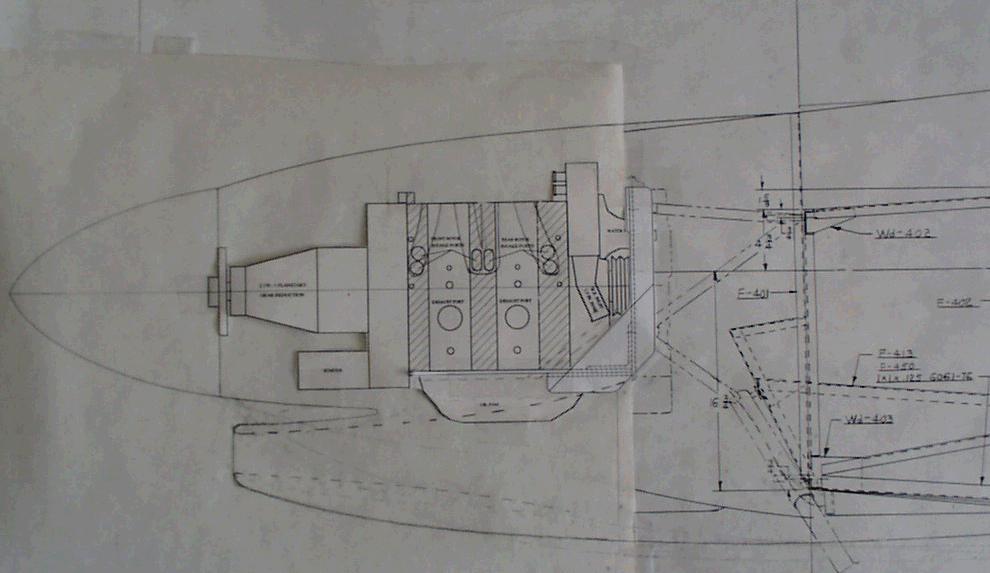
 Attached is a picture showing how the mount (in an earlier rendition) and
motor fit on the side view plan of the RV4.

 Please keep those comments coming. I'm not totally committed to this yet
and appreciate the input.

Mike Wills
Mike please keep the pixel count down when you scan this stuff.
That huge jpg was real hard to crop. I could not have done it without
the
virtual screens that come with Linux :-) PL

The Aircraft Rotary Engine Newsletter.              Powered by Linux.

http://home.earthlink.net/~rotaryeng/            http://www.linux.org