Don Moncrieff wrote:
Thanks Paul
Your prompt response to my first "Advice please" letter is much
appreciated. You set me to wondering things that I otherwise might not
have considered.
Your mention of Paul Yaw and his use of a 13B Turbo is exciting. I would
guite like to get in touch with him and share his learnings. I don't
mind learning the hard way, but if I can bypass that and get "do" and
"don't" guidlines from someone who has walked the road in front of me,
I'm all for that. Your advice brought the following thoughts to mind.
1. Ken Welter [owner of the rotary Coot]
(Richard A. Steeves, ed of The Coot-Builder's Newsletter,
rsteeves@facstaff.wisc.edu  knows how to contact Ken) who has used
nitrous to get his Coot off the water, was, I'm told, thinking about
switching to turbo because it was difficult to carry enough nitrous with
him to far away lakes, rivers, etc. and the nitrous was hard on his 13B.
His experience, as I heard about it, led me to go with turbo to start. I
figured if I could get one hp for every two lbs of engine I'd be OK.
I figured I'd use stock stuff in so far as I could as an experiment in
making the use of a 13B as easy as possible. I had everything I needed
cheep for an 87 13B from a Japanese car parts dealer here in Toronto.
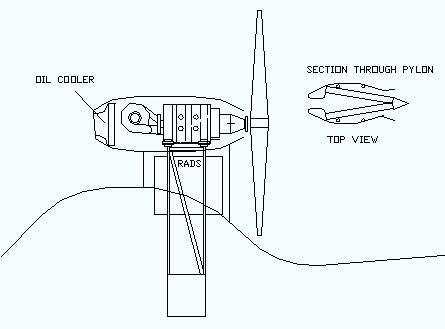
The turbo adds 8 inches to the right side of the core.
For the Coot I would mount the turbo sideways in front of the engine
and plumb it back to keep the cross sectional area down. I would
mouunt the oil cooler in front of that.

I would then angle mount two large area thin rads in a V shape in the
pylon
with an exit slot in front of the prop. The pylon structure tubes will
not measureably affect the air flow.

With the recent knowledge we have learned about
angled rads diffuser/ducts this is practical. All this will
pay off in range and I know you need that up in Canada.
All this sounds like a lot of fun. :-) PL
I mounted the oil
cooler on the left side for symmetry and convenience.So with the
intercooler on top I have a package that is 27 inches wide and 23 inches
high. Coot performance is poor anyway so I've not been very concerned
about losing a few  mph. I thought any of the Redrives I've seen could
hide behind that pile of paraphernalia.
3. The Coot is a rudder plane. From what I've heard owners find that
with a 30 or 40 degree bank the ailerons are not able to lift the low
wing and opposit rudder is needed to get the craft level. I thought to
counter this by enlarging my ailerons and decreasing the leverage the
engine has on top of the pylon by lowering the engine. This calls for a
9 to 10 inch offset in the Redrive.
4.Further, I know of one Coot-13B situation (experienced by Bruce
Buksyk) where pressure from the prop drive shaft pushing directly on the
end of the engine excetric shaft caused so much bearing dammage that the
engine had to be totally dismantled and repared before it could be
flown. This encouraged me to find a Redrive in which there was no
possibility of the prop shaft pressing on the excentric shaft. I hear
good things about a Northwerst Aero Redrive, but I'm still looking for
advise on the issue.
5. Your idea of putting the engine in the fuselage and using a very long
belt appeals to me. My problem with it is that I have a couple years
worth of work (I'm slow) putting fuel tanks,  control cables and push
rods in the area where the engine would have to go. I'd like to fly
before my health gives out (I'm 68) so I've opted for the pylon approach
recommended by Molt Taylor the designer, though in a shortened form.
6. I have room for a 74 inch dia prop--maybe a bit more. Ken uses lots
of blades.
7. So comparing where I am with my project to your advice I continue to
explore options and seek the best. Thanks to you I have some new ideas.
I continue looking for advice.
Thanks, Don