Howard Wilkinson wrote:
Join the Home Foundrymen's Association:
http://members.xoom.com/HWilkinson/index.htm
 My interests in aviation and engines in particular has led me to
look into casting aluminum in my own shop as there are dozens of uses
for custom castings.  There are a lot of people doing half assed
castings of poor quality  at home......  But it is not a difficult
thing to create good quality molds and good quality pours using the
right metals, and proper fluxing and degassing procedures.
 As with most things people do as a hobby endeavor the effort and
cost required to do it right is not that much more than to do it
poorly.
 I started a new organization, and opened up a new mailing list
dedicated to the home foundryman,  The organization is called HFA
"Home Foundryman's Association" and our mailing list which is an
unmoderated general discussion list is called "hobbicast".  Membership
is free.... This organization and list are for the purpose of enabling
people to share information and experience and to encourage people to
undertake casting projects.

    Please visit the HFA web site at:

http://members.xoom.com/HWilkinson/index.htm

You may join the organization and/or the mailing list here, and check
out our links pages as well as add your own links.  To make this thing
work we need participation.... Please Join

You may also join the list at:   http://hobbicast.listbot.com/

Or you may join the list by simply sending a blank E-Mail message to:

hobbicast-subscribe@listbot.com

There is not a lot of activity yet on this list, but I hope to recruit
enough interested parties to get things happening.   Paul Encoyland of
Budget Casting Supply is a great resource person who is a list member
as well as a great source for materials and information.  This is not
an aviation specific list or organization.... anybody is welcome to
discuss casting aircraft parts, engine parts, art casting, or
whatever.  I want to hear it all.
 Techniques available to us include sand casting (paul sells a very
high quality fine grain mix) investment casting using ceramic or
plaster, and permanent mold casting which uses iron or steel molds.
Lost wax investment casting is capable of producing some very detailed
precision parts, and is used in art and jewelry work.  Sand casting
with good quality sand will produce good accurate parts, and is
inexpensive, but will not produce the fine detail investment casting
will.  Permanent mold casting is only suitable for production of a
fair number of the same part such as for example redrive housings.

Please check this out and join if you are interested....     H.W.
Good post Howard! Thanks.

Mazda used lost wax technique in the Leman's four rotor
engine to reduce the weight of the rotors and up the RPM.

Lost wax cast iron endhousing would be great. We know
where to get them lapped and nitrided. We could copy
the late 3rd gen end housings to solve the high turbo
HP cracking problems in the earlier engines.

Aluminum end housings would be possible but you would
have to get them detonation gun  sprayed with ceramic
wear surfaces. There will be an increased market for
this kind of stuff as the supply of low cost Mazda
parts starts to dry up.

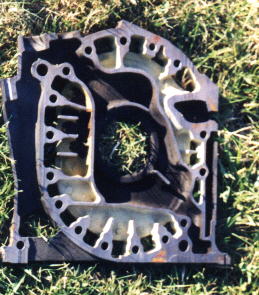
Here is a jpg of a sectioned end housings. BTW Note the black
oil drain backs. This is the main reason it is a good idea
to mount the engine upright and not on its side.

All those channels in there are necessary to get the coolant
to go where it is supposed too.

Paul Lamar

The Aircraft Rotary Engine Newsletter.              Powered by Linux.

http://home.earthlink.net/~rotaryeng/            http://www.linux.org