Ken Gillanders wrote:
Dear Paul,

I have been following your newsletter for the past few months and have
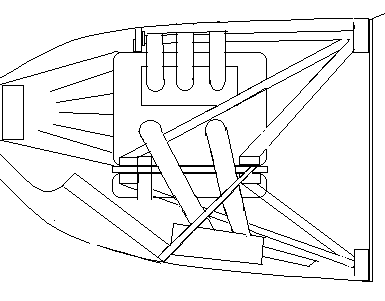
learned a great deal about rotaries, mounts ect. I have sent a mock up
side and front view of my proposed mount for my BD4 project. I was
wondering if you could comment on the design and any suggestions would
be greatly appreciated. I have an earlier model 4 port core that has
been completely rebuild following Tracy's conversion guide and Bruce's
video (which I both highly recommend). I would like to put the pan
below the aluminum bed plate with holes drilled for the baffle.
Question? What are the pros and cons to keeping one rubber mount below
the plate as opposed to sandwhich two rubber mounts on top and bottom
of the plate. With the latter, you would not be welding the top and
bottom support together? My proposed diagram shows the sandwhich
version, just as Tracy's does.
The big problem Ken is those rads. You need to increase the area and
fold them back along side the engine.

Four Barry mounts would do the trick in a 3/4 inch plate but it would be
very heavy unless it was milled out in most places. Better to use
a 1/4 inch plate and thicken it up where the Barry mounts go.

The heat from the engine will melt the Barry rubber mounts so you need
to
copy the Barry mounts using silicon rubber sheet donuts RTV'ed together.
The silicone rubber mounts should be good for 300 degrees.

Paul Lamar
Paul,
Ken Gillanders wrote:
Thanks for getting back to me. I'm a newbie and I am sure you have already
discussed surface area for the rads. How much is enough? What about air
conditioner evaporator core's for the rads? I am assuming that the aluminum
plate I suggested will be effected by the heat, therefore the 1/4" plate is
the material of choice for this application. I was just trying to save some
weight.

Ken
Well what seems to be best is one large rad about 19 inches wide
by about 22 inches long two inches thick under the engine. See some
drawings on the web site http://home.earthlink.net/~rotaryeng/

Paul Lamar


The Aircraft Rotary Engine Newsletter.              Powered by Linux.

http://home.earthlink.net/~rotaryeng/            http://www.linux.org